One of the tropes in Cannabis culture is that there’s nothing like growing your own flowers. Well, this isn’t true for me.
To be honest, although I’ve grown a few plants, I never got hooked on growing weed. Making Cannabis journalism my career has meant that oftentimes great Cannabis comes my way, and because I roll in a group of master cultivators, their weed is often exceptional, while mine is always so-so. Because of this, I didn’t grow my own crop this year, or at least I thought I wasn’t going to … until now.
My main mentor in the weed game is horticulture expert and author Ed Rosenthal. I’ve known Rosenthal for years and worked on several books with him. Beyond that, we are neighbors and see each other socially quite often. Rosenthal is always experimenting in his home grows, trying to see what techniques work best for growing Cannabis.
One year, he turned his plants on their sides to see if he could get more lateral branches stretching toward the sun rather than grow big top colas. Last year, he was working on growing plants with single stems. These plants had almost no branches and produced one main line of buds. The idea is that the single-stem plants are easier to harvest and have a faster turnaround time because they spend less time in the vegetative stage.
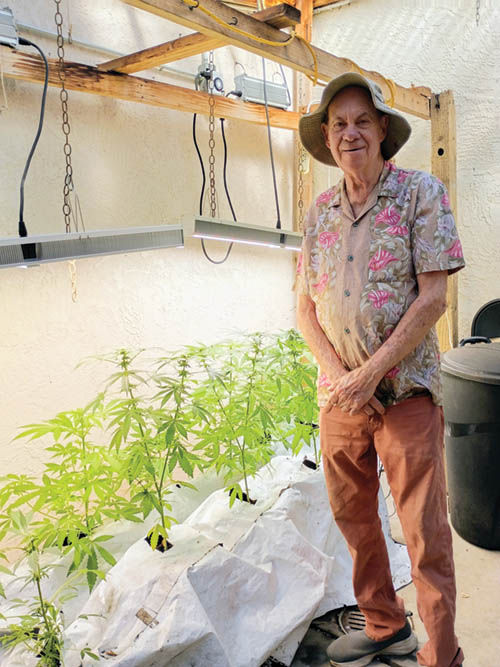
This year, Rosenthal popped some autoflower seeds and started experimenting with how minimally he could work with them so they would produce flowers. His home greenhouse setup includes five hours of supplemental LED lighting, an aerated plastic trash can filled with water and nutrients, 3-gallon pots filled with clay pebbles on the bottom and soil on top and a heated water reservoir beneath the pots that lets the plants draw water as needed. The plants are covered in panda plastic white side up to prevent insects, keep the containers cool and stop water from evaporating.
There was one snag in his plan this year, though. Rosenthal has been on a quest to relegalize Cannabis in India, a place where he has formative memories from his younger days, and set off on a long trip at the beginning of October.
That’s where I come in; I’m set to give the plants 2 quarts of water a week and watch them for about a month to see when they are ready to harvest. Then, I’ll have to harvest, dry, cure and trim them. In exchange, Rosenthal said I can keep most of the buds.
“The plants take care of themselves,” Rosenthal said while giving me the instructions for the setup. “The lights go on every day, and I give them about five hours of extra light, and then they do the rest themselves. It’s up to them.”
This low-maintenance setup is designed to minimize daily human involvement. The seeds were started in Rockwool cubes around late August or early September. The clay pebbles act like a wick, drawing water up from the reservoir below through capillary action, like a tissue pulls water from a glass.
“A lot of people like to take care of their plants every day and think that plants need their help, but plants have been around for hundreds of millions of years, and they did pretty well without humans,” Rosenthal said. “And so, as long as they get the requirements met — enough light, enough nutrients, enough water, enough air for the roots — they can take care of themselves. This shows that they don’t really need human love and, you know, caresses.”
Rosenthal told me that next year he might replace my role watering the plants once a week by using the force of gravity. It feels like a blow to have my labor replaced by a natural phenomenon, but I understand. It’s all part of making growing Cannabis easier for all of us.
By next year, I’m sure Rosenthal will be trying other methods of growing as part of his never-ending project to grow pot in the simplest way. And, this year, that involves recruiting me as a somewhat reluctant Cannabis cultivator.
In the end, Rosenthal and I will probably have some weed to smoke. And, who knows, maybe the simplicity of the setup will help me finally fall in line with one of his most famous quotes: “Marijuana may not be addictive, but growing it is.”