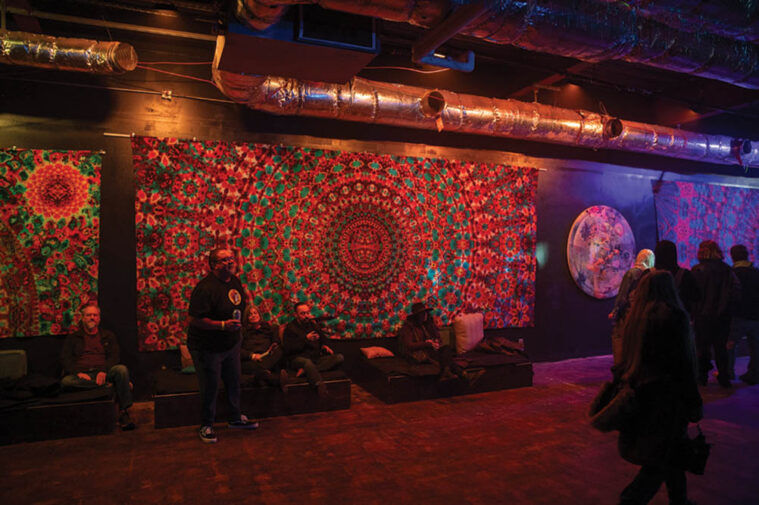
On a recent December weekend in Grass Valley, California — not far from the redwood-spined heartlands of psychedelic America — The Chambers Project gallery unveiled “60 Years of the Grateful Dead,” a sweeping, reverent retrospective of the band’s visual and cultural impact. Co-presented with the Psychedelic Arts and Culture Trust, the show captures not just the band’s artwork but also the full scope of a still-thriving creative lineage. From Rick Griffin’s molten lettering to Banjo’s sculptural glass reinterpretation of “Aoxomoxoa,” it’s a tribute to what the Dead were, the world they built and what they’ve made possible.
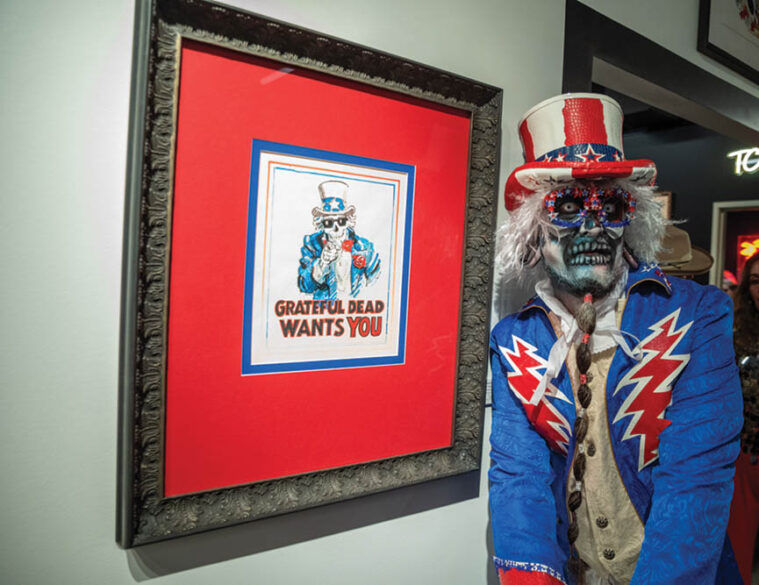
Curated by Chambers Project founder Brian Chambers, the show gathers original artworks, sketches, posters and never-before-exhibited pieces that shaped the Grateful Dead’s visual identity. “The Dead have always been a nexus of creativity,” Chambers said. “There’s a whole visual vocabulary that followed them and influenced so much beyond them.”
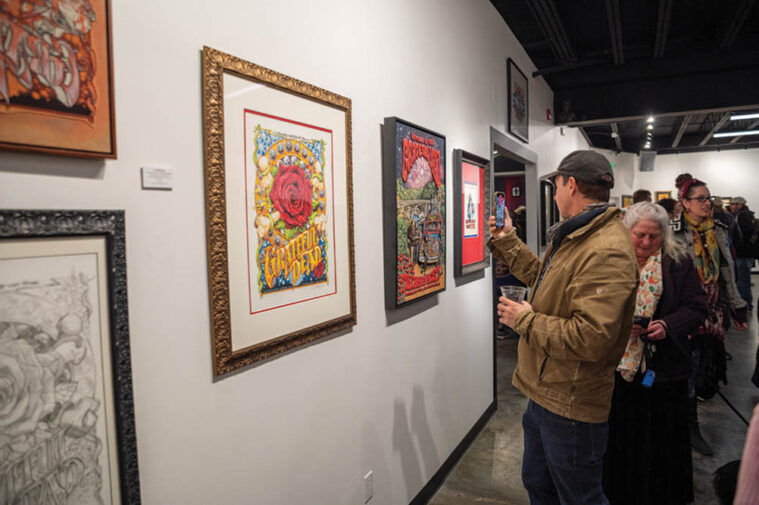
Works by Rick Griffin, Stanley Mouse, Alton Kelley, Victor Moscoso, Wes Wilson and others anchor the historical core of the show, with seminal items like Griffin’s original “Aoxomoxoa” drawing and Bill Walker’s evolving “Anthem of the Sun” mandala commanding the room. But the retrospective also folds in the future, placing legacy alongside contemporary voices like AJ Masthay and Zoltron — artists who extend the poster lineage into modern counterculture (and the latter of whom co-curated the exhibit with Chambers).
One of the exhibition’s most talked about pieces comes from Banjo, a master glass artist whose career traces directly back to Grateful Dead parking lots.
“I started blowing glass in 1999, and at that time, the artistic pipe scene was still a tiny offshoot of the Grateful Dead community,” Banjo said. “Bob Snodgrass was selling color-changing pipes on tour with the Dead in the mid-’80s — that’s the genesis of this whole movement.”
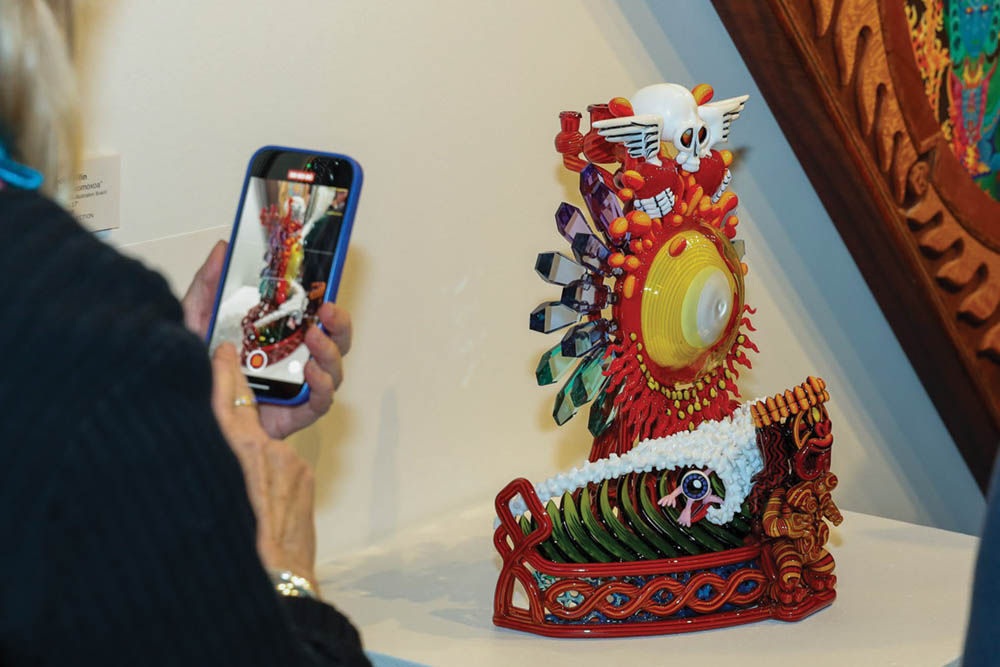
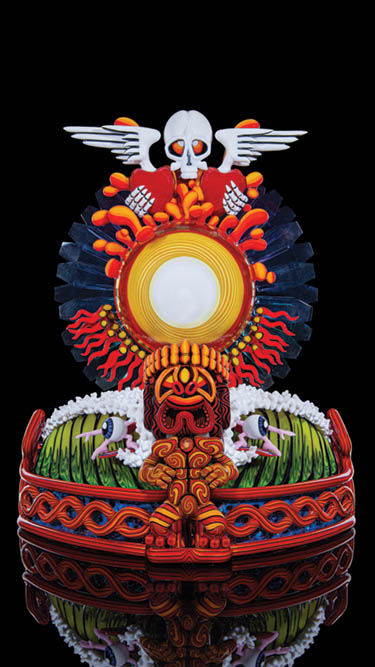
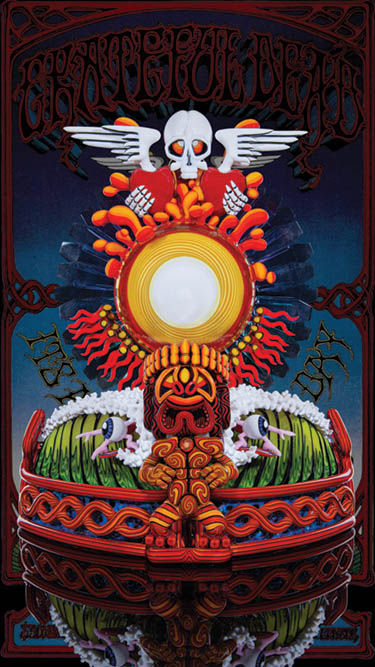
Banjo’s centerpiece is a sculptural glass tribute to Griffin’s “Hawaiian Aoxomoxoa” poster, a 1969 image commissioned for a show that never happened. “It’s arguably Griffin’s masterpiece,” Banjo said. “The wings, the sun, the lava, the skull — it’s this elemental invocation of life and death. He spoke about it in terms of ovums and fetuses and skulls. You can feel it all in that piece.”
Over four months, Banjo translated that 2D image into an intricately layered, fully functional glass pipe, complete with miniature surfers, breaking waves, lava flows and a radiant sun chamber. “I didn’t want it to just be a sculpture that sat there,” he said. “The challenge was to make it something that worked, that ripped and still honored the sacred geometry and composition of Rick’s original.”
Glass, for Banjo and many in the scene, isn’t just a medium but a ritual, elemental act. “Glass is earth, water, air and fire. You melt sand with flame and breathe it into form,” he said. “It’s ancestral. People are drawn to it on a primal level, the way we’re drawn to fire. Add Cannabis to that, and it becomes a deeply intentional ritual.”
Those points of origin — fire, glass, music and Cannabis — are where the Dead’s influence ripples most profoundly. “The pipe scene literally grew out of the Dead tours,” Banjo said. “It was people selling pipes next to tie-dyes and hemp necklaces. We didn’t have color palettes back then. Just the culture, the creativity, the weed and a sense of reverence.”
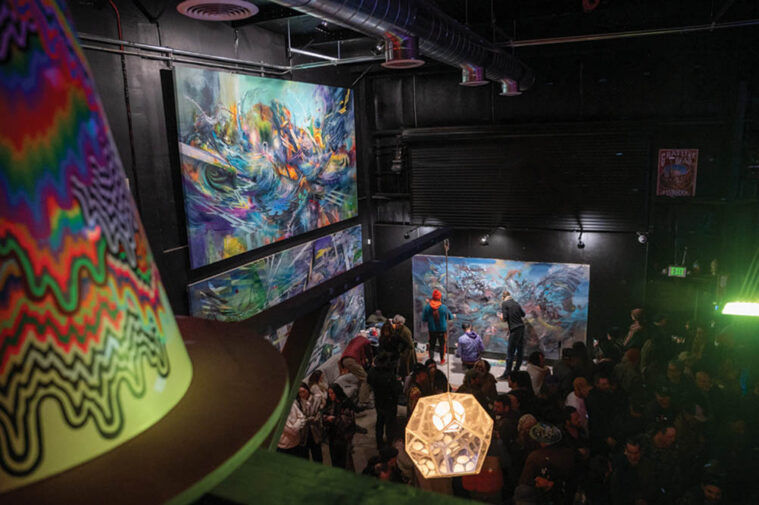
The Dead Retrospective show puts that lineage on full display. At the opening weekend, a one-night supergroup dubbed White Lightning — featuring Grahame Lesh, Pete Sears, John Molo and others — played the Bodhi Hive in Nevada City. Simultaneously, a dedicated glass section within the show, curated by Banjo, showcased other leading artists from the functional glass movement. That section will expand into a stand-alone exhibition opening January 31 titled “Glass Is Dead” — a nod to both the scene’s origin and its continuous evolution.
“There’s been stigma, especially in the fine art world,” Banjo said. “We were shunned — it was illegal, it wasn’t refined, and people didn’t see the art. But that’s changed. Now, the Corning Museum of Glass is flying me and my son out to teach glass pipe classes. There are pipes in their museum store. It’s finally being recognized as serious, transformative work.”
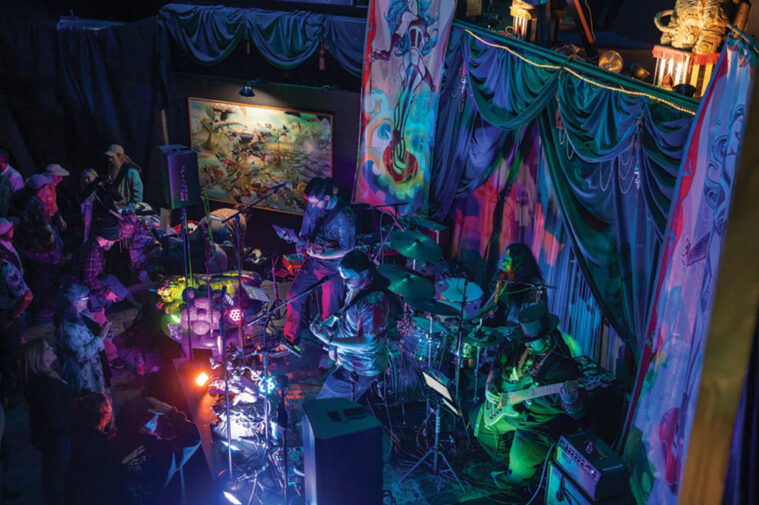
Chambers sees the exhibits — and PACT’s formal debut — as launchpads. “This was a celebration, but also a signal,” he said. “We’re entering a phase where these shows are going to be curated with museum-level intention and historical grounding. We’re not just preserving — now, we’re expanding.”
The Retrospective exhibition runs through June 1 with evolving programming that reflects the multiverse of creativity the Dead catalyzed: jewelry, clothing, poster art, projection and sound. As Banjo put it, “It’s not just glass. It’s a full spectrum of subcultures that emerged because of this one band. And they’re still alive.”
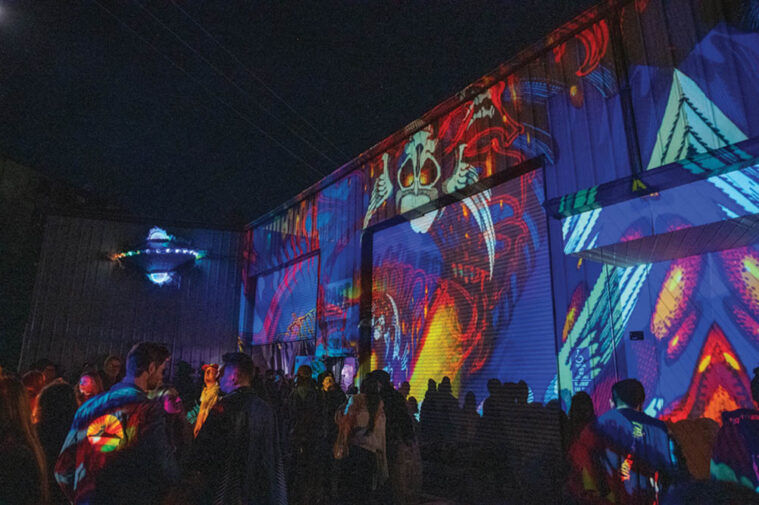
In the heart of the gallery, amid Griffin’s ink lines and Banjo’s molten reimagining, that much is obvious: glass is dead — long live the Dead.
“60 Years of the Grateful Dead” is on view now through June 1, 2026, at The Chambers Project
627 E. Main St., Grass Valley, CA
Monday-Friday, 10 a.m.-5 p.m.
“Glass Is Dead” opens January 31.
thechambersproject.com | @the_chambers_project | @banjoglass