There is a moment on the Big Island of Hawaii when your breath slows to the tempo of the crashing waves, you notice the salt and ash in the breeze and you are struck by the sense that Earth is a living ancestor.
Maybe it’s the molten lava running through the Earth’s caverns beneath your feet, a reminder that this land is the domain of Tūtū Pele, the fire goddess of Hawaii. She is our great-grandmother, an ancestral spirit to be respected, honored and approached with deep humility. The type of humble respect a glassblower embodies when the alchemy of these fragile yet timeless creations begins.
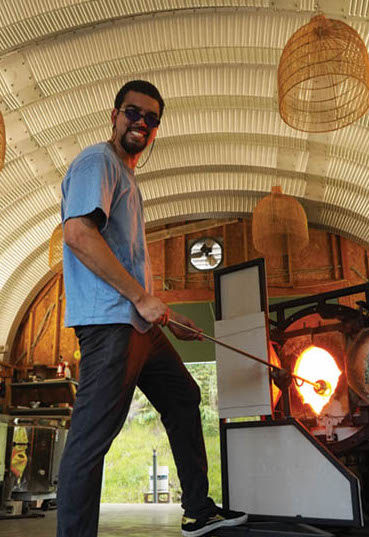
It is in this reverence that Julius Gutierrez steps into a relationship with grandfather fire, not as a tool, but as a living elder, one that echoes the same elemental energy as the lava rivers of Pele herself.
At Moe Hot Glass, guided by master glassblower Daniel Moe, Gutierrez has spent eight years shaping more than glass. He is shaping story, lineage and elemental memory, drawing from a land where fire is both destroyer and creator, where Pele’s breath reshapes the island in real time.
Can you introduce yourself in your own words and share what’s been moving through your world lately?
“I’m a farmer, a father, a psychonaut exploring biology, chemistry and playing with different elements,” Gutierrez said. “Nature moves through my reality daily and inspires my work.”
You carry Peruviano and Braziliano roots while living on the Big Island. How do your bloodlines and the land beneath your feet shape the way you approach the flame?
He speaks of Peru first, of tight-knit Indigenous South American roots bound by the joy of a big familia. It was his familia’s move to Hawaii that awakened his awareness to a deep systemic concern for native sovereignty.
“Seeing what happened here to the Kānaka Māoli tribes lit a fire in me to help represent Indigenous voices,” Gutierrez shared.
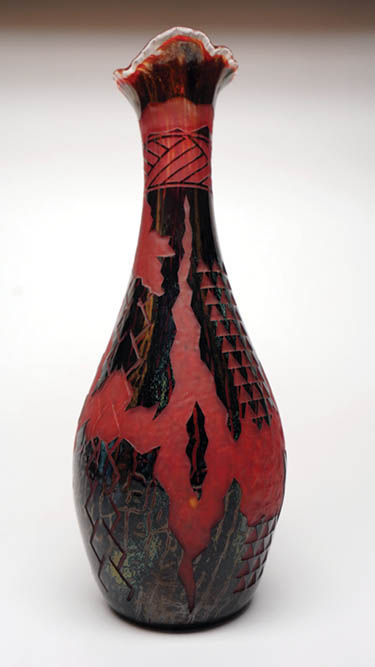
His pieces carry that intention: Hawaiian lineage patterns, tribal geometries etched not as decoration, but as protection, remembrance and resistance. In many ways, they mirror the markings of the land itself, lava fissures and flows shaped by Pele’s hand.
Our readers love Pakalolo. Do you have a favorite strain or preferred method of consumption?
“A good homegrown Super Silver Haze,” Gutierrez said. “I prefer to dab uplifting strains because they are simple, clean and quick.”
Have you blown your own smoke chalices?
“In my intro to glass class at the university, they told us we can’t create bongs. So naturally, I made it a point to create a few of them,” he said with a smirk of rebellion. “Those pieces, once everyday tools, are now cherished artifacts marking the beginning of my collection.”
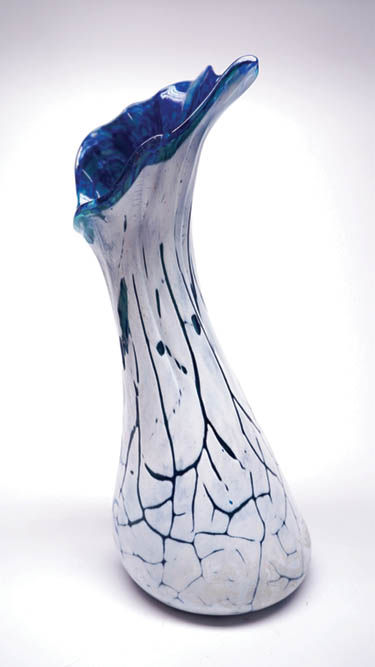
Many people see glassblowing as a craft, but others feel it is a ceremony. What does it represent to you?
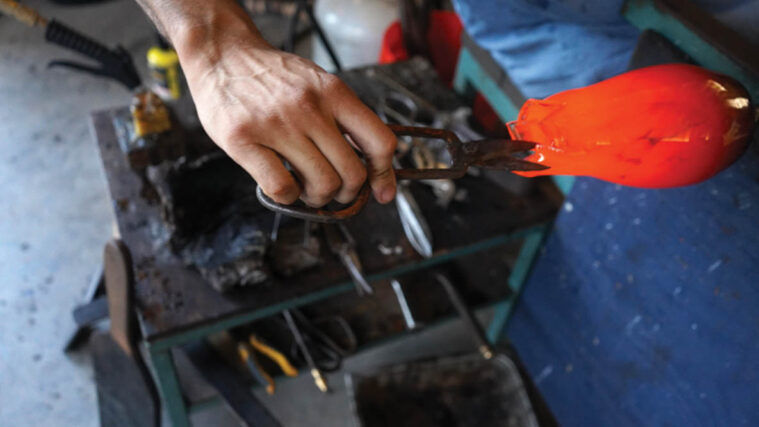
“I feel like the very act of glassblowing is ceremonial,” he said. “When you get into the flow state with the flame, it’s like a trance, everything else falls away.”
Here, fire becomes more than heat; it becomes a teacher. The process demands full presence, where breath and flame cocreate form.
Gutierrez speaks of ancient lineages of glass once guarded as sacred technology, of Roman and Egyptian techniques still not fully understood today. In his view, glass is a crystal capable of holding intention.
Living on an island where lava flows beneath the surface, do you feel a relationship between your work and that living earth energy?
“It feels like I’m playing with lava,” he said. “I’ll go watch the lava flow, then go straight into the shop and work with something similar.”
The connection is visceral. Lava and glass are both born of heat, both carrying the story of transformation.
“In those moments, the boundary between studio and landscape dissolves. The furnace becomes a contained volcano, the blowpipe an extension of breath,” Gutierrez said. “I’ve even joked about blowing glass from the lava herself.”
He dreams of one day creating glass directly from Hawaii’s own silica, allowing Pele’s body to become the medium.
There’s an alchemy to turning sand into glass. What does that transformation teach you?
“It teaches you to stay levelheaded and to let go. Glass breaks. You have to practice nonattachment,” he said. “There is humility in the flame. No matter the skill, no piece is guaranteed. Beauty can collapse in an instant, just as land can be reshaped overnight by lava’s flow.”
In this way, the practice becomes spiritual, an ongoing lesson in surrender to forces greater than oneself. Gutierrez works primarily with soft glass, an ancient form known for its fluidity and sensitivity. Unlike more rigid materials, it requires constant attention.
“You’re fully dancing with it,” he explained. “The process is physical, sweat, movement, breath, an orchestration of body and molten elements.”
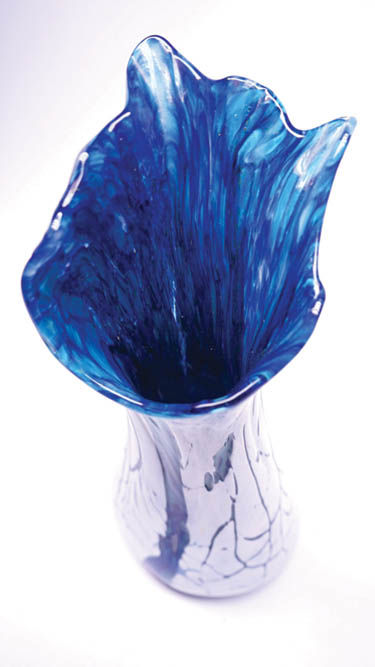
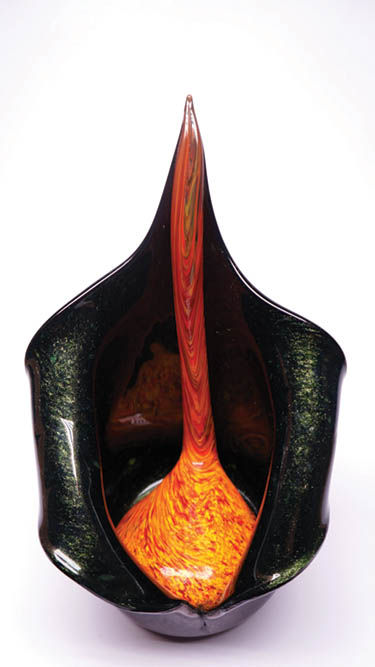
That intimacy gives his pieces a living quality. His lava vessels feel like they’re still flowing, like they could shift at any moment. His ocean forms hold motion within stillness, echoing the meeting place of land and sea.
One sculptural piece — an open, womb-like form lined with crystalline green — was inspired by the place his daughter, Andará, was conceived, merging land, lineage and life into a single form.
What do you hope people feel when they hold your work?
“Childlike wonder,” he said simply. “Curiosity for understanding how these pieces were made.”
Perhaps that is the true medicine of his work, not just the visual representation of the objects themselves, but the feeling they awaken. A return to the youthful essence of awe.
In a world that often forgets its connection to the elements, Gutierrez stands in the fire as both student and storyteller. Through flame and form, he reminds us, OGs, that creativity is a living ceremony in motion.
huhonuaaquaponics.com | moehotglass.com | @aworldofjulius | @inka_glass | @moehotglass