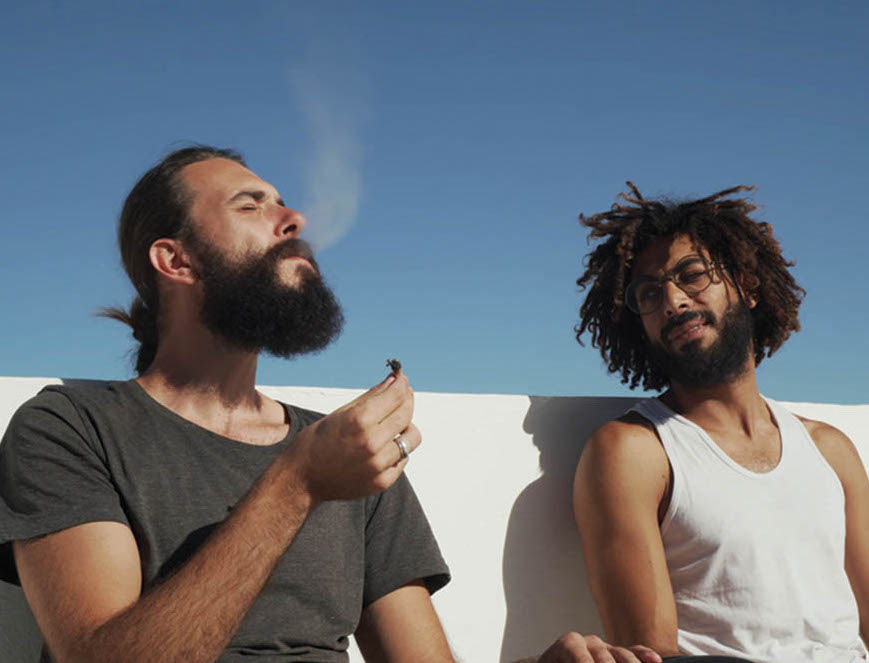
Cannabis has always made more sense outdoors — it’s a plant. So it holds that the lifestyle around its consumption would flow that way, too: on patios, around fire pits, in backyards, where people settle into lawn chairs and accidentally stay until dark and sometimes fall asleep. It belongs to long conversations, warm evenings and the particular luxury of having nowhere else to be.
That was what I kept thinking about at Rose Buds, a recent first-time gathering hosted by Bri of Blazin With Bri and Erica of Alternative Standard in San Diego. They plan to make it an ongoing series. On a hot Sunday afternoon, a few dozen women spent several hours arranging flowers, rolling herb-infused joints, sharing flower from Moon Made Farms and doing something the Cannabis industry talks about constantly but the Man doesn’t always make easy: simply spending time together over a toke.
The setup was thoughtful without feeling overproduced. Erica’s floral company, Florera Era, led a bouquet workshop. Geli Taase — better known online as @geli.fication and as the founder of Antisocial CannaMom Club — hosted an intentional bong-hit station. There was brunch, flower, conversation and plenty of opportunities to wander from one activity to the next without feeling like you were missing something important. The whole shebang was sponsored by dispensary owner, author and Cannabis activist J.M. Balbuena.
My favorite part was that nobody seemed particularly interested in optimizing their afternoon. I’ve been to enough Cannabis events to recognize the usual rhythm. Conferences, networking mixers, launch parties, educational panels, trade shows. There is always another event somewhere on the calendar. Most of them are useful. Many are genuinely enjoyable. But they often carry the low-level hum of productivity. People are making connections, building businesses, introducing products and chasing opportunities. Even when everyone is having a good time, there is usually an underlying purpose, and it can feel stale after a time.
It was at Rose Buds that I realized: The Cannabis industry has plenty of events, but what it lacks are social spaces. That’s a strange reality for a culture built around sharing joints.
We have dispensaries, brands, increasingly sophisticated products, celebrity partnerships, investor decks, educational seminars and every imaginable consumption format. What we don’t have are many places where people can casually gather around Cannabis without a transaction attached.
Public consumption remains heavily restricted. Lounges are still relatively rare. Even in legal states, Cannabis is often something people purchase publicly and, I think, mostly consume privately. Access, as we know, isn’t exactly all there most places you go, even in California, the so-called home of Cannabis culture.
As a result, genuinely social Cannabis experiences still feel uncommon, and the irony is that Cannabis itself pushes people in the opposite direction: A joint passed around a circle changes the pace of a conversation almost immediately. Stories get longer, tangents become the point. People stop worrying so much about what comes next. The ritual encourages lingering, which may be one of the reasons the plant has remained socially relevant for so long.
Watching people move through Rose Buds, I kept noticing how quickly strangers became familiar. Conversations expanded and contracted throughout the afternoon. People drifted between flower arranging, rolling joints, sitting in the shade and talking. Some attendees arrived with friends; others came alone. Not everyone worked in the industry, and those who did had plenty of other things to talk about: parenthood, fashion, politics, our childhoods.
The Cannabis industry talks constantly about community. Sometimes I wonder if we mistake proximity to the industry for community itself; I don’t think they’re automatically the same thing. Community isn’t a panel discussion or networking opportunity, though, sure, it can be part of it. It’s not just a carefully curated marketing activation. Most of the time, it’s much less impressive than that. It’s people spending enough time together for familiarity to emerge.
Rose Buds wasn’t memorable because of the flowers or the bong station, though both were lovely. It was memorable because it felt ordinary. A group of people sitting outside, smoking weed, arranging flowers, talking for hours and lingering longer than they intended should not feel unusual in 2026 — but it actually still does. And I suspect it’s that way for many tokers across the nation, especially in less-legal states.
That says as much about the state of Cannabis culture as any conference ever could.