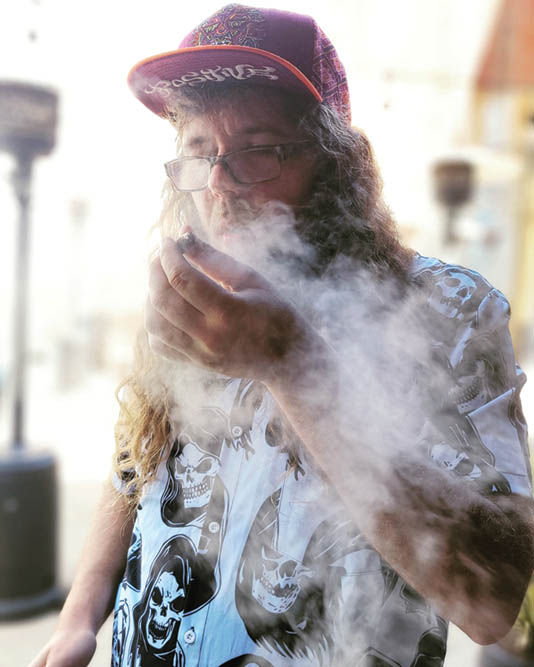
With new types of Cannabis being released by breeders at a clip that resembles the speed of artificial intelligence technology, it’s tough to keep up with the strains that will not only pop, but persevere. One person who always has his lungs in the game is esteemed Cannabis journalist Jimi Devine (@jimidevine2.0).
At this point, Jimi has called more winners than the Associated Press. Often heard saying he smokes weed “in every tax bracket,” Jimi is one of the world’s most renowned experts when it comes to strains and Cannabis culture. A go-to expert for a breadth of Cannabis publications, the influential effects of his predictions for what’s hot cannot be denied. The strains Jimi brings to life on the page go on to win Cannabis competitions and shape the tastes in Cannabis worldwide.
Jimi and I first met more than a decade ago, when I was working as an editor for Cannabis Now magazine, which was based in downtown Berkeley, California. Jimi’s energy has always been infectious, and while the world has changed a lot since then, he has stayed consistent. He wears bright, bold prints, and he has a booming voice and a distinct laugh. His approachability, enthusiasm and refined palate set the foundations for his success as a bon vivant.
Hunting the Heat
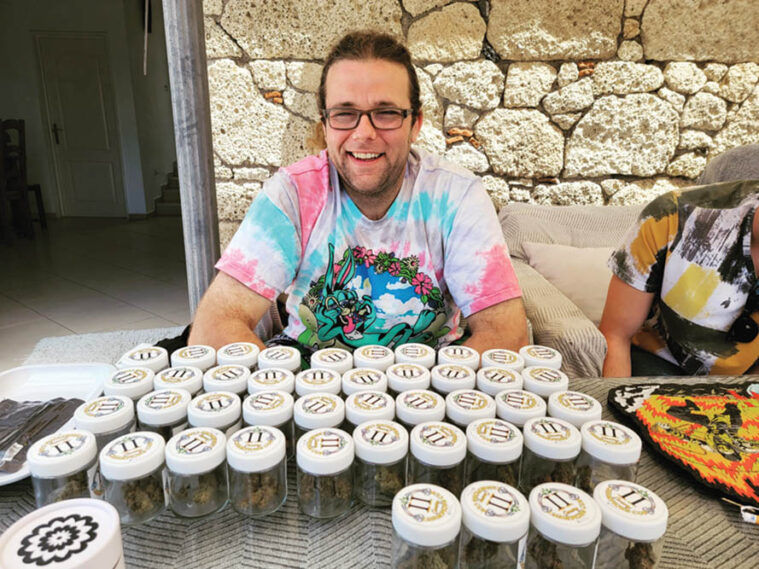
California remains the heartland for Cannabis culture across the globe; strains that make it in the Golden State can be found on menus of Cannabis clubs in far-off places like Barcelona, Spain. Originally from Lynn, Massachusetts, Jimi moved to the San Francisco Bay Area in 2009 with a dream of working in the Cannabis industry. Through connections he had made as a student activist, Jimi landed a job at the Cannabis Buyer’s Club of Berkeley. Founded in 1996, CBCB is the nation’s oldest active Cannabis dispensary and continues to serve as Jimi’s home base for assessing “the heat,” a mission that has taken him around the world as a judge at elite Cannabis competitions.
Since 2019, Jimi’s also been hosting his own Cannabis competitions, such as the Transbay Challenge and Heatquest. At trade shows, he invented an activity called a “weed walk,” which is more of a rapid-fire jog where he goes to each booth and smells all the jars of Cannabis on offer.
Putting in almost five years as the Cannabis columnist for LA Weekly, Jimi’s Cannabis coverage bridged the gap between the famed Northern California Cannabis-growing region of the Emerald Triangle and Los Angeles, the core of Cannabis commerce in California. Through his work selecting and featuring strains that he thinks are winners, Jimi has become one of the most trusted Cannabis chroniclers of our time.
Occupy Weed Street
Once only shared through oral tradition, the stories behind the creation of new Cannabis strains are often misattributed by those who don’t do the work of speaking directly to the source. Jimi’s strategy for predicting the next best thing in weed involves closely following Cannabis breeders and seeing what they’re excited about.
“Sure, anybody can pop a scene that might be their golden ticket, and it might change the game,” Jimi said. “But then in this recent era, you haven’t really seen too many bag seeds change the world.”
Jimi explains that Cannabis breeding in the modern era involves advanced selection and propagation processes. The strains that stick have attributes you’d expect, like incredible flavor, but for a global takeover, strains also need commercial viability, and breeders need to be ready to scale up.
“It’s not like you’ve got a four lighter in your garage anymore,” he said. “If you’re investing all these resources into warehouses, crazy greenhouses, whatever, you lean a lot more on commercial viability than people did pre-Prop 64. Like, obviously, you always wanted to be making money, but also the pound price was so much higher. Commercial viability was a very different thing back then. If you knew it was going to be worth $4(K) or $5K a pound … Obviously, there’s a very thin layer of exotics at the very top of the market that maybe still reach those prices. But it’s like Occupy Weed Street; it is the 1% of the 1%. Most of this stuff just doesn’t come close to those numbers.”
A Better Balance
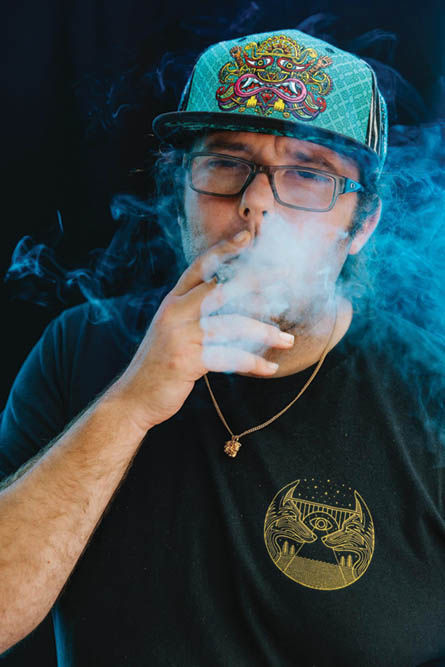

When asked to predict what’s ahead for Cannabis strains and culture, Jimi homed in on the potency of pot and foresees a return to strains with higher THC percentages.
“We’re in this, like, weed light era, where everyone’s kind of chasing terpene profiles — things that taste good, things that wash good. But in the process of chasing those things, the actual potency of most of the Cannabis we see these days is way down than it was when it was when I got to California, or even when I was back in Boston, the OG era and stuff like that, back when Chemdog was big, when Sours were big,” he said. “All those things tasted good, but they also hit. I feel like there’s a lot of Z light crosses out there these days that are just like the Bud Light of weed.
“I think there’s going to be a place for high-impact strains in the years to come as people want to chase that down again. It’s crazy to me right now that that’s just such a back burner part of the conversation and part of the selection process, just actually getting high, and I pray that we’ll see a movement back to a better balance of potency and flavor.”
Jimi rightfully attests that there hasn’t been a big flavor wave in Cannabis since Z — which emerged in 2013 — noting that many of today’s popular strains are Z crosses. Sweet flower profiles are here to stay, he said, because the consumer market continues to demand strains that taste and smell like candy and desserts.
Keeping It Real
Over the years, Jimi’s been able to forecast the strains that go on to win awards at events like The Emerald Cup and Zalympix. A big part of his success in finding strain trends is because of the relationships he’s established. As he says, he can’t predict the winners if breeders don’t put the weed in front of him.
“It starts back with the breeders’ trust that they know — my opinions — I’m gonna be real about it,” Jimi said. “I don’t really put down any strains even if I don’t like it. I feel like you only have so much spotlight to build, so why write about things you don’t like?”
Jimi credits his positivity with getting him access to the coolest things to smoke. Remaining humble, he acknowledges that while his writing sets trends in motion, for strains to become successful, the accolades have to come from multiple channels.
“I think the validation coming from a bunch of different points in the community makes for the best pedigree for a strain, not any one person saying it’s fire,” he said.
While he rarely sings his own praises, following the weed world with Jimi as a guide will keep you in touch with the pulse of Cannabis culture.
“The cool thing about being me is that I’m me because I spent all my professional career talking about other people,” Jimi said. “It’s fun to create value for people that are putting in so much effort to make these amazing strains for us.”