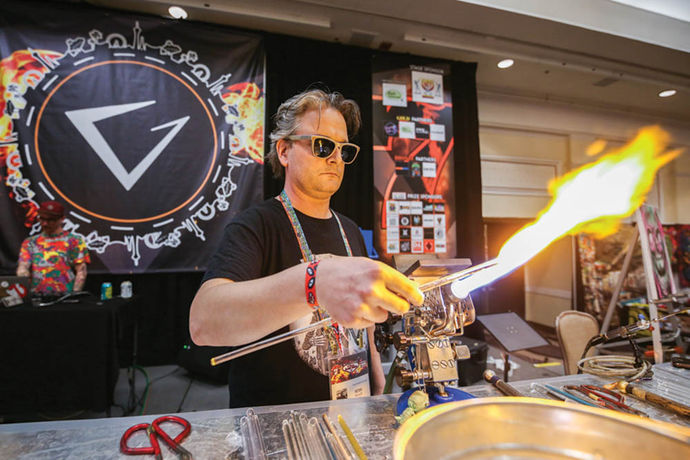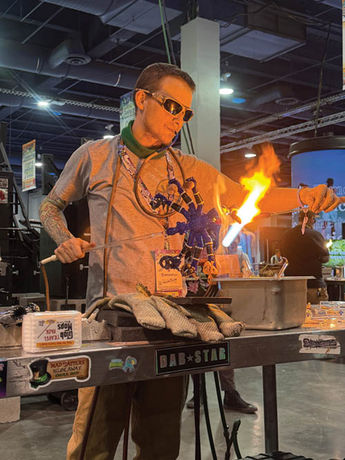
Ryan Rosburg is 46 now, but he was just 15 years old when he started melting glass.
As a child, the now-glass artist was obsessed with fire and drawn to anything creative, so it was a natural progression for Rosburg’s artistic output to be led by the torch. Or, as Rosburg put it, “If I’m really honest, I would say that after I smoked weed for the first time, I really wanted to make things to smoke weed out of.”
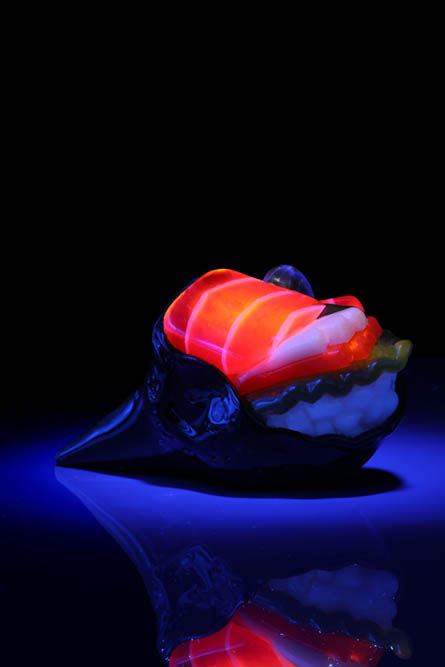
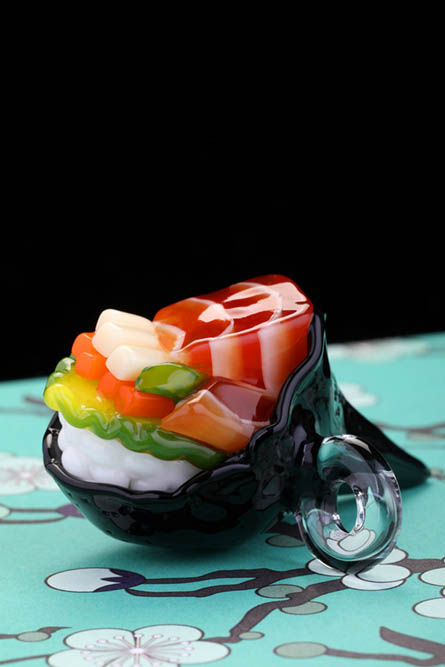
He said his biggest influences early on were sculptural soft glass legends like Lucio Bubbacco and Milon Townsend. He was inspired by the way they worked with scale and the attention to detail in the figurines they made.
Another major inspiration for Rosburg was the 19th-century duo from Bohemia in the Czech Republic, brothers Leopold and Rudolf Blaschka. The glass artists are best known today for their botanically correct models of plants that were commissioned for, and still remain at, the Harvard Museum of Natural History. In one amazing feat, they created around 4,400 glass models that represent over 830 plant species.
That inspiration took root for him in Colorado, where — while growing up and after just getting on the torch — Rosburg was fortunate enough to make the acquaintance of glass artist Homer Hoyt. Hoyt is world-renowned for authoring his 1989 book, “Glassblowing: An Introduction to Solid and Blown Glass Sculpturing.” He became a mentor of sorts to Rosburg, who said Hoyt was “helpful with advice and really kind. He was older in those days, but still very sharp and present. My first reamer and graphite tools were handed down from him.”
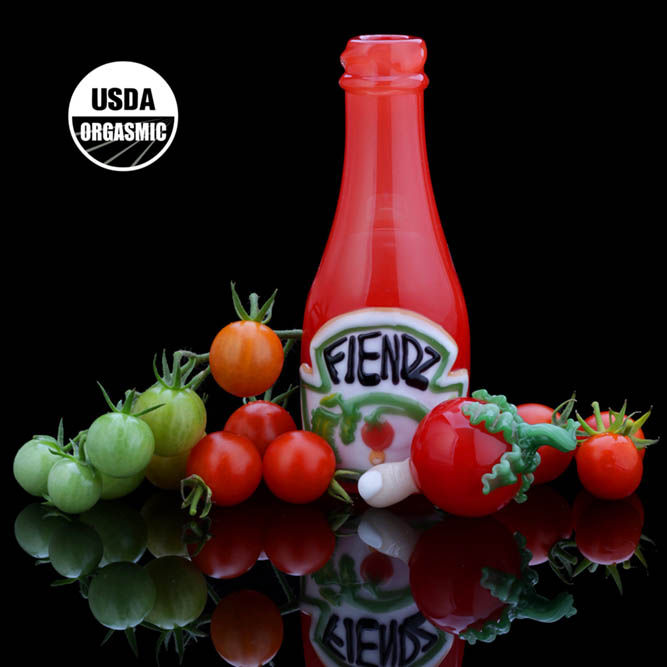
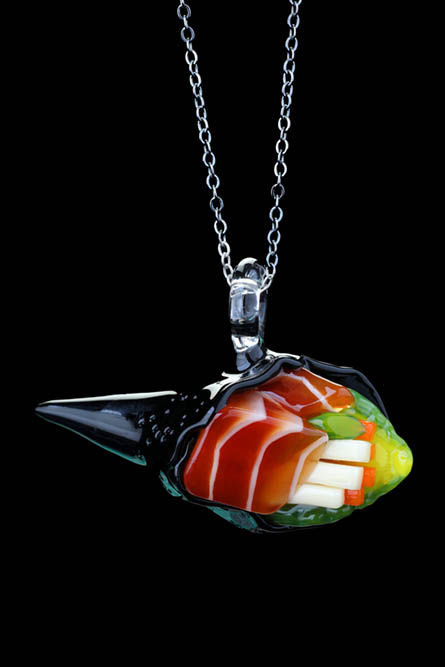
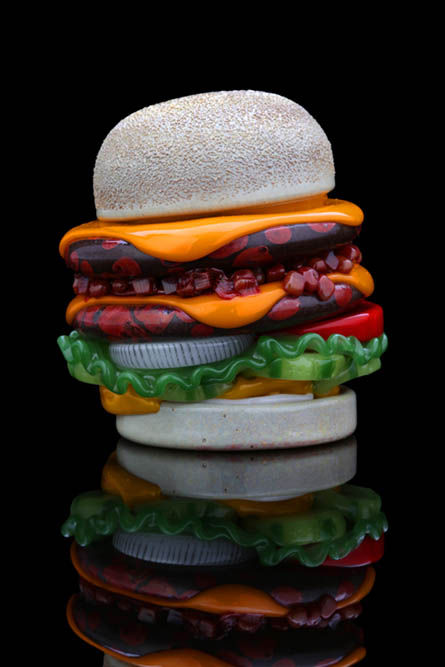
Rosburg continued to develop his craft in Colorado until 2016, when he landed in The Whiteaker, an arts district and well-known mecca for glass artists in Eugene, Oregon. He’s still there today, continuing down the rabbit hole, where his use of borosilicate glass and flameworking creates stunningly realistic pieces of art that supersede many others who attempt the same craft. The first piece I saw of his was an extremely realistic miniature burger pendant. I was blown away by the level of detail and proportion; needless to say, I’m still a fan to this day.
These days, his repertoire includes all manner of edible delicacies and anatomically correct sculptures. In the future, he said he plans to continue expanding his portfolio to include more expressive works — kind of like storytelling in a way — in whatever direction his imagination leads.
While talking to Rosburg, I had to ask, “What are your visions for the future of the glass art industry?” He said it’s a “big question.”
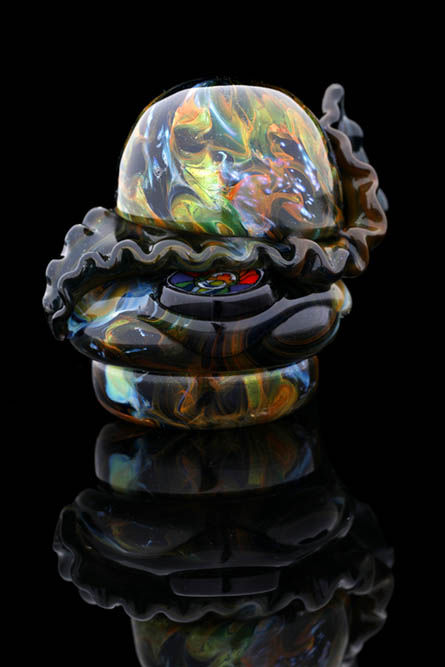
“I really have no idea what’s in store for the future of all things, but I do know that people will always keep doing it,” Rosburg said. “There will be glass art, glass pipes and the people who enjoy making them, plus the people who support it. There will also be those who don’t support our industry, and we’re still under the thumb of hands much bigger than our own.”
“Our reach is limited and still pretty underground. I see that every time I watch a current movie and see an old acrylic bong that just looks like the old, outdated relic that it is,” Rosburg said, adding that it’s likely how many people still view the pipe industry today.
“A device for burnouts and the reckless left over from the hippies of the ‘60s and ‘70s,” Rosburg said. “Movies are an effective zeitgeist for trends, and it seems we really haven’t quite made it to the stage yet.”