Ain’t No Way but Higher
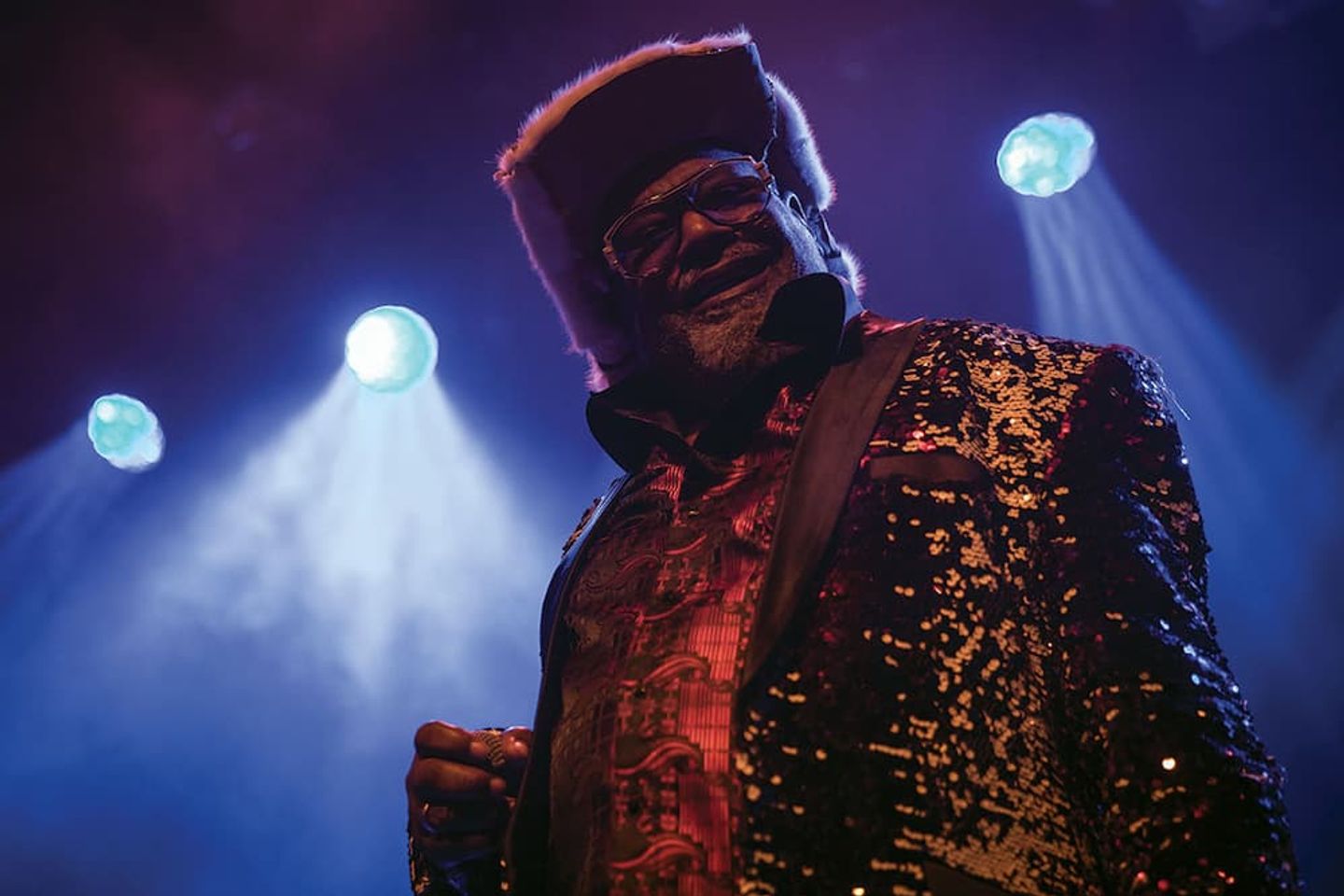
The psychedelic circus of sound known as Parliament-Funkadelic created a unique fusion of Motown, Detroit rock and Afrofuturism that would come to define the funk genre. P-Funk’s weed and LSD-fueled jams kept a generation’s booties grooving, laid the foundation for hip-hop and established its founder/frontman George Clinton as the undisputed King of Funk.
Jersey Boys
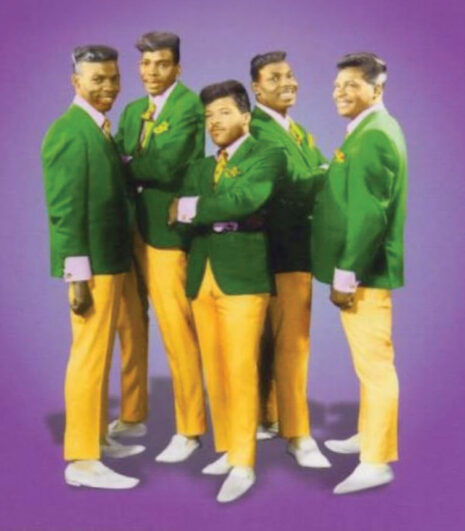
Believe it or not, Parliament-Funkadelic began as a doo-wop quintet in a barbershop in Plainfield, New Jersey, called the Silk Palace. There, young George Clinton worked as a hair processor — frying the hair of local “pimps, preachers, politicians, and players” with hot lye and potatoes.
Clinton grew up in Newark in the early 1950s and fell in love with Motown. In 1955, at just 14, he started a singing group, The Parliaments. They rehearsed in the shop’s backroom, making the Palace a neighborhood hub for music. Later, the group added a five-piece backup band and recorded a few singles, which Clinton claims he paid for using a bag of counterfeit $20 bills he acquired through the Outlaws street gang.
Detroit Rock City
In 1963, The Parliaments drove to Detroit and auditioned for Motown, but Berry Gordy declined to sign them — allegedly saying they were too ugly. Clinton was hired as a songwriter though, and began commuting to Motor City weekly before fully relocating the band there a few years later.
Eventually, The Parliaments signed with the short-lived Revilot Records, and finally scored a Top 20 hit with “(I Wanna) Testify” in August 1967. Unfortunately, though, by then doo-wop was falling out of fashion: it was the Summer of Love, and rock and roll was all the rage.
“We got there, and The Beatles had ‘Sgt. Pepper.’ That changed the world,” Clinton told the Red Bull Music Academy in 2015. “We immediately had to get rid of our suits. We were going to do what they was calling hippies.”
Not all ’60s rock was about peace and love, though; After signing with Ann Arbor’s Diversified Management, The Parliaments began gigging with the agency’s other acts — radical rockers like the Amboy Dukes, The Stooges, and the MC5.
“We were called the Bad Boys of Ann Arbor,” Clinton told Red Bull, recounting an incident when they were nearly arrested on a plane because the MC5 smoked weed during the flight. Among those “bad boys” was the MC5’s manager, Cannabis activist/White Panther John Sinclair, who was notoriously sentenced to 10 years for two joints in 1969.
“We had to picket and lobby for almost a year and a half to get him out of jail,” said Clinton. “We used to have smoke-ins on the weekend in the park in Ann Arbor. The whole school would just come up to the park and light up.”
Free Your Mind…
While touring the “Chitlin Circuit” and colleges, the boys always sniffed out the good smoke.
“Sugar Shack was a club in Boston that we played a lot … in the early days around ’69,” Clinton told French Toast last year. “During that time, there was some really good weed out. I think it was called Acapulco Gold. I don’t think I ever got that high again until the ’90s with Chronic.”
And it wasn’t just marijuana: one night at the Shack, students from Timothy Leary’s Harvard psychology lab invited them to try LSD. Clinton told “Tales from the Tour Bus”: We all took it…Let them watch you for four hours, got the $64 or whatever it was … it was the best job I ever had! One hit, that was it — it don’t seem like we ever came down!”
What’s a Funkadelic?
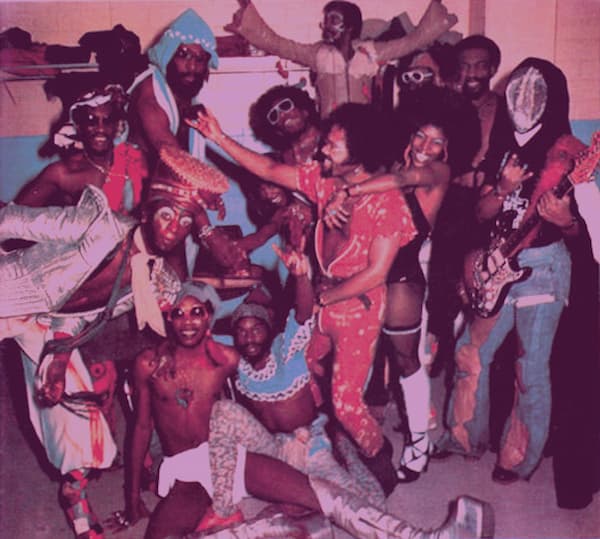
After a contract dispute with Revilot (who owned the name “The Parliaments”), Clinton refused to record any new material for them. Instead, he brought the backing band to the fore and rebranded the group as The Funkadelics — a portmanteau of “funk” and “psychedelic” coined by bassist “Billy Bass” Nelson. Later shortened to simply “Funkadelic,” this new configuration invented a unique fusion of Motown, Detroit rock and psychedelia that would come to define the funk genre.
Clinton signed Funkadelic to Westbound Records and recorded their self-titled debut in 1970. That same year, Revilot went under, and The Parliaments’ name reverted to Clinton. Dropping the “s,” he signed Parliament to Invictus Records and released another album, “Osmium.” Thus began their decades-long practice of releasing albums under different labels and names — with Parliament supplying the more polished, danceable grooves and Funkadelic delivering the heavier, more experimental jams.
Give Up the Funk
In the early 70s, the band added several new stars to their ranks — including keyboardist Bernie Worrell, as well as bassist William Earl “Bootsy” Collins and the Pacemakers (James Brown’s backing band) — and churned out one mind-blowing album after another, such as “Free Your Mind … and Your Ass Will Follow” (recorded in one day while tripping balls) and “Maggot Brain” in 1971, and “Up for the Down Stroke” in 1974.
By this time, the band (now touring as Parliament-Funkadelic, or P-Funk) had developed an outlandish stage show with extravagant outfits and wild antics — which, in turn, often invited wild behavior from the audiences. On “TTFTB,” Clinton recalled one performance in Oklahoma where a stripper in overalls came on stage smoking a joint, then proceeded to drop trou, bend over and blow smoke rings from her booty hole.
By 1975, P-Funk had recruited more of Brown’s former band members, including saxophonist Maceo Parker and trombonist Fred Wesley. It was this epically expanded incarnation that would produce their magnum opus, “Mothership Connection.”
The Mothership
“Mothership Connection” was a concept album set in, as BBC Music put it, “a future universe where black astronauts interact with alien worlds.” The inspiration for this space-themed epic came primarily from Clinton, who it turns out was a die-hard Trekkie and sci-fi stan.
“I was a big fan of Star Trek, so we did a thing with a pimp sitting in a spaceship shaped like a Cadillac, and we did all these James Brown-type grooves, but with street talk and ghetto slang,” he once explained to Cleveland’s Scene magazine.
Featuring some of their most infectious hits — such as “P-Funk (Wants to Get Funked Up)” and “Give Up the Funk (Tear the Roof off the Sucker) — 1975’s “Mothership” went Gold in just four months (as did their next album, 1976’s “Clones of Dr. Funkenstein.”)
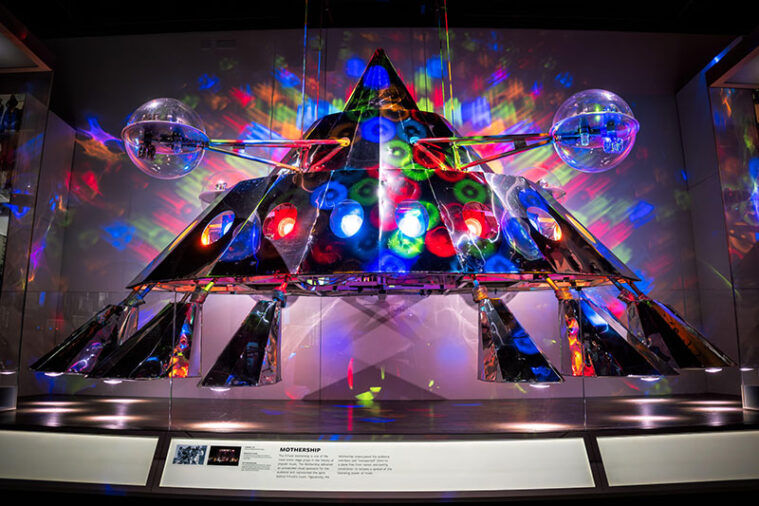
For their P-Funk Earth Tour (1976-1977), they developed a Blaxploitation-meets-Broadway style funk opera with colorful characters (like Clinton’s Dr. Funkenstein), shiny costumes and their most ambitious prop yet: a full-blown flying saucer. Clinton convinced Casablanca to spend half a million dollars on the show (the highest-ever budget for black artists), $275,000 of which went toward constructing the 1,200-pound Mothership.
Each night, “enviromedian” James Jackson would introduce the band while lighting a giant, six-foot joint in a huge skull’s mouth. The band appeared in a cloud of smoke. At the show’s climax, the Mothership would descend from the rafters onto the stage spewing light, sparks and fire. When the hatch opened, Dr. Funkenstein would emerge dressed like an intergalactic pimp. It’s primarily because of this funk-filled sci-fi spectacular that P-Funk are considered pioneers of what later became known as Afrofuturism.
Rock Bottom
Over the next decade, P-Funk recorded at least a dozen more albums, featuring classic hits like “Flashlight,” “Bop Gun (Endangered Species)” and “One Nation Under a Groove.” But as with so many other great artists, their drug use eventually caught up to them.
“For some reason, at a certain point, LSD just stopped working for everybody. It was no longer that beautiful trip that made you think and feel good — that was gone,” Clinton told TTFTB” “So I started doing crack.”
By 1982, the band had fallen so deeply into debt that they sold the iconic Mothership for scrap metal. That debt, along with numerous copyright and royalty squabbles, led Clinton to officially disband both Parliament and Funkadelic. Though he continued to record with P-Funk members, few of those projects were as successful. The Godfather of Funk, it seemed, had lost his mojo; little did he realize that P-Funk’s grooves were about to become bigger than ever in a surprising new way.
Back in Our Minds
With hip-hop emerging as a cultural force in the late 1980s, many funk jams were resurrected as backbeats of rap songs. Or, as Clinton puts it, “Funk is the DNA for hip-hop.”
Over the years, countless P-Funk grooves have been sampled by hip-hop’s biggest stars, including Run-DMC, Public Enemy, N.W.A., Ice Cube, Tupac and De La Soul. Hell, Clinton’s 1982 hit “Atomic Dog” alone has been sampled over 300 times — most famously in Snoop Dogg’s debut solo single “Who Am I? (What’s My Name?).”
Speaking of Snoop, let’s not forget Snoop and Dre’s 1992 classic “The Chronic,” which incorporated so much of P-Funk’s music that it established its own new style of gangster rap called “G-Funk.” In fact, the high-pitched synth sound that became the hallmark of West Coast rap originated with P-Funk, making Clinton one of the undisputed grandfathers of hip-hop.
Let’s Make it Last
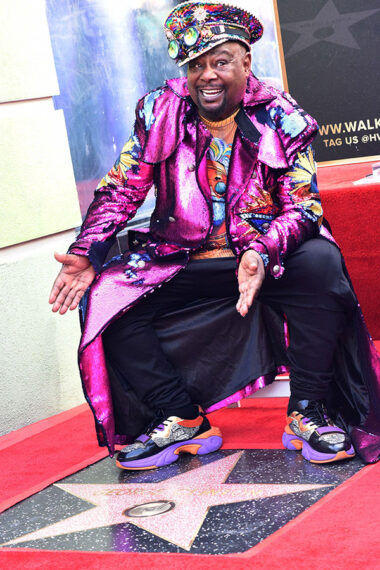
Over the decades, P-Funk have received many honors, most notably an induction into the Rock and Roll Hall of Fame and a Grammy Lifetime Achievement Award. Clinton has been awarded several honorary degrees (making Dr. Funkenstein an actual doctor) and a star on the Hollywood Walk of Fame. In 2011, “Mothership Connection” was added to the Library of Congress, and a recreation of the ship from their “Mothership Reconnection Tour” now resides at the Smithsonian’s National Museum of African American History and Culture.
Meanwhile, Clinton continues to tour and record with his P-Funk All Stars, including 2018’s “Medicaid Fraud Dogg” — a musical critique of pharmaceuticals, which Clinton has sworn off in favor of medical marijuana.
“They sell you all kinds of drugs you can’t pronounce, then give you another one to get off the first one,” he told Forbes last spring. “Cannabis could’ve handled a lot of it, if they’d just let it.”
More importantly, though, in 2011, Clinton finally kicked his 30-year crack addiction — also with the help of Cannabis.
“When I finally stopped smoking crack and started smoking weed, I [thought], ‘I done wasted my time and my money,”’ Clinton told High Times in 2018. “I realized I should’ve been smoking weed all along, because that’s the high I was looking for.”
Now 84, he’s recently partnered with rapper Wiz Khalifa (who portrayed him in the 2023 film “Spinning Gold”) to launch his own weed brand called — what else — The Funk.
“Just like the music lifts your spirit, The Funk elevates your consciousness to a whole new dimension,” Clinton testifies. “The Funk carries the same cosmic energy that’s been powering our music since we first told everybody to “Free your mind ….”