
Shelah Wind-Smith, lead facilitator and co-founder of Ripple Journeywork, has had a close relationship with psychedelics and caregiving for most of her life. She grew up as a Jehovah’s Witness in what she describes as a “highly controlled religious environment.” After several formative encounters with psychedelics, she experienced a fundamental shift in her perception of herself and the world. Immersing herself in festival culture, she witnessed individuals who struggled as a result of not having enough support while using substances in overstimulating environments. She started volunteering in harm reduction, using her nursing experience to help others.
A background in medicine and watching her mother undergo a hellacious battle with cancer inspired her work in the Cannabis industry, eventually leading to her creation of the award-winning Cannabis brand Green Goddess Gardens. But when Oregon announced legislation to support psilocybin treatment centers, Wind-Smith had an epiphany.
“I thought about everything that I loved and didn’t love about caring for people, being burned out with nursing, and wanting to serve people in a safe way. Given all the experience I had in harm reduction and safe access and community, I just wanted to get plugged into this unique opportunity,” Wind-Smith explained.
With that, the seeds, or in this case, spores, for Ripple Journeywork were planted.
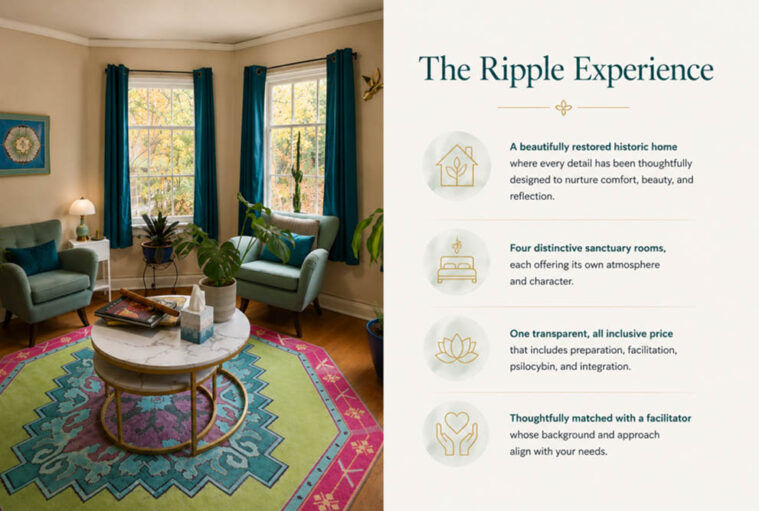
Ripple Journeywork is a psilocybin service center built out of the same ethos that shaped the Oregon Medical Marijuana Program era of Cannabis: craft, care and community first.
While Cannabis and psilocybin are both forms of ancient plant medicine that have reduced human suffering across cultures and time, Cannabis tends to be consumed more habitually and at a higher frequency than psilocybin, which is typically approached with increased intention. Oregon’s model of psilocybin treatment is unique in that it is designed to be relationship centered between the facilitator and patient. Preparation, trust and integration are essential parts of the process that can be just as important as the psilocybin facilitation itself.
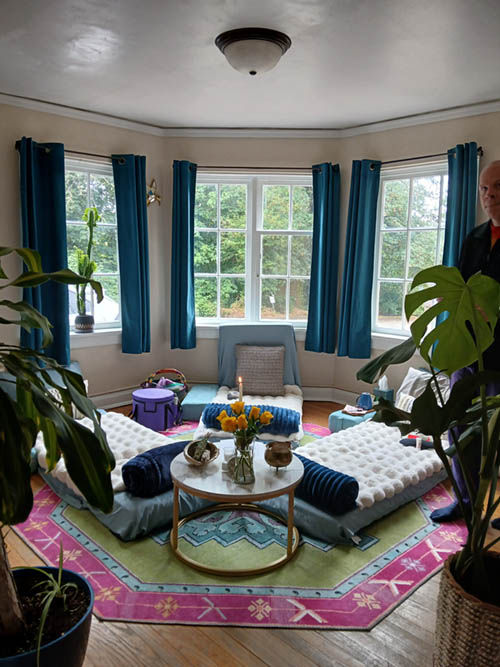
The service framework at Ripple Journeywork emphasizes providing as much space and time as necessary to identify the client’s support network and personal preferences prior to service delivery. Ideally, the more rapport and understanding developed between the facilitator and the recipient, the more effectively the facilitator can personalize the experience and provide support during the psilocybin session. Preparedness reduces the likelihood or severity of a bad trip, but it also helps create an ideal container for the session, nurturing the opportunity for deeper levels of connection with one’s true self in a safe environment.
“It’s really just about building a relationship during preparation and then figuring out all of their personal preferences, what they want this container to actually look like, what things they might want to bring into the experience, whether it’s religious or super ceremonial, or what music they might want. It’s all customized to that individual,” Wind-Smith said.
After psilocybin is administered, an integration session is encouraged within 72 hours, where the client debriefs the experience with a facilitator. The Latin root of the word “integration” is to “make whole or complete” and, as such, it’s usually where the real work gets done in processing and making sense of the experience.
According to Wind-Smith and the Healing Advocacy Fund, over 20,000 individuals have received psilocybin services under this facilitated model of care in Oregon for a range of ailments from treatment-resistant depression to complex post-traumatic stress. Of those numbers, the vast majority of recipients experience reduced symptom severity as a result.
Ripple Journeywork sets strong intentions for supporting clients in the community, and they work hard to make the service accessible for individuals in need.

“I’d say about 35% of our clientele have either gotten sliding-scale pricing or scholarship assistance to be able to have access to this,” Wind-Smith explained. “(I have a) long-term hope of seeing these services become accessible through the Oregon Health Plan, much like other alternative approaches such as massage or acupuncture.”
Significant progress has been achieved in making psilocybin services accessible through legalization, but there is still a lot of work to be done. Since the state first legalized psilocybin treatment in 2020, many service centers have opened and closed. Oregon’s model is centered on preparation, safety and integration, which is an incredibly important foundation for clients’ well-being, but some current costs and regulations are prohibitive, creating barriers to access to care. Current legislation is proposing to increase the license fee for service centers from $10,000 to $20,000 and for individual facilitators from $2,000 to $4,000.
“I absolutely love maintaining a safe program; it’s essential. But my concern is that if these licensing costs increase dramatically, it’s eventually going to affect the clients. Every service center is trying to balance accessibility with being sustainable and keeping the lights on. My hope is that Oregon continues protecting safety while making sure this regulated care model remains financially viable for providers and accessible for the people who need it,” Wind-Smith said.
“I hope that people remember Ripple as a place where they felt safe enough to be fully human. And I hope that clients remember it as a place where they were met with dignity and compassion,” she noted. “To watch people get reconnected with themselves and just be better for the world, it ripples out into families, which ripples out into communities and beyond. It’s pretty amazing to watch people and how this work can really transform them.”