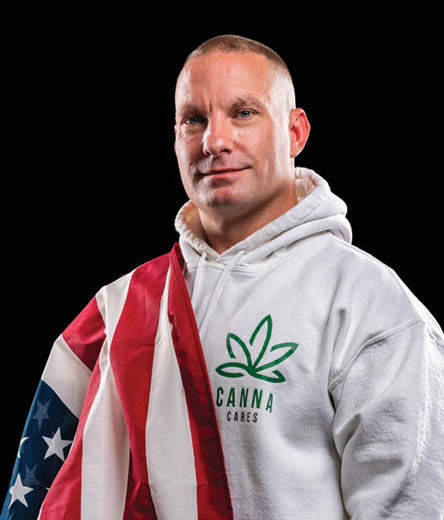
When Rick Glass thinks about Iraq, he doesn’t begin with politics. He remembers the sound.
A Maryland native who grew up an hour outside Washington, D.C., Glass was close enough to Saddam Hussein’s statue to hear it being toppled. Days earlier, his unit had assaulted Al-Faw Palace and was trying to replenish ammunition when they came under heavy fire.
His friend, John Keeney, was hit by a sniper’s round in the elbow.
“I was eating an MRE, and while I heard rounds going overhead, that one sounded very different,” the Marine recalled, noting it took 13 surgeries to save his gunner’s arm.
Years later, Glass would come to understand that surviving combat was only the beginning of his battle.
“I woke up angry for years,” he said. “And in all honesty, I still wake up angry.”
As the United States approaches the 25th anniversary of Sept. 11, Glass knows that day will carry a weight difficult for most Americans to understand.
“The 25th anniversary of 9/11 is going to evoke a lot of emotion for me,” he said, “because I know it’s part of the reason why I served time in combat.”
Glass doesn’t question the horror of Sept. 11. What he questions is what came afterward — and whether the sacrifices made by people like him were justified.
“I’m patriotic, but I also think it’s good to question things, including your government,” he said.
“I guess I’m still looking for those weapons of mass destruction,” he added, shaking his head.
Sometimes, Glass said, veterans need a reason for losing someone. They convince themselves that their fallen friends died for a greater purpose. But genuine healing may require confronting something harder.
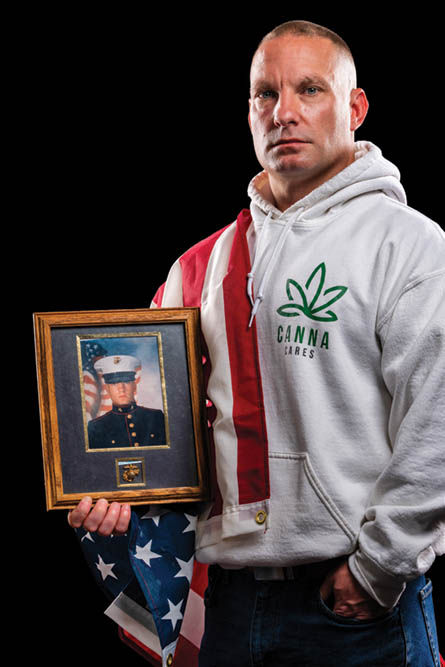
“There are some people in that picture who aren’t here today, and don’t get me wrong, they’re heroes — every last one of them,” Glass said. “But their death is also a result of their government lying.”
He knows how provocative that sounds to another veteran.
“When you say to another veteran, ‘Your buddy died in vain,’ that’s enough for them to want to physically confront you,” he said. “But if we’re talking from a true place of healing, we might have to really come to a place of, like, ‘Dude, we don’t have to lie to each other anymore.’”
Glass eventually found himself fighting another war — one that followed him home.
On April 19, 2017, he was arrested for his third DUI.
He now credits the Westminster Police Department with giving him his sobriety date: April 20. At the time, Glass didn’t even use Cannabis.
“420 is a holiday that I used to make fun of my Cannabis-consuming friends for celebrating,” he said. “And now it’s one of the biggest days of the year for me.”
Sobriety forced Glass to confront things he had spent years avoiding.
While drinking, he convinced himself that he enjoyed shaving in the shower. He told himself it gave him a closer shave, but what he was really doing was dodging a necessary conversation with his reflection.
“The only thing I was doing was avoiding looking at myself in that mirror,” he said.
Recovery meant becoming willing to look.
Nine years into sobriety, Glass is married, a homeowner for the first time in his life and credits his wife as one of the most stabilizing forces in his recovery.
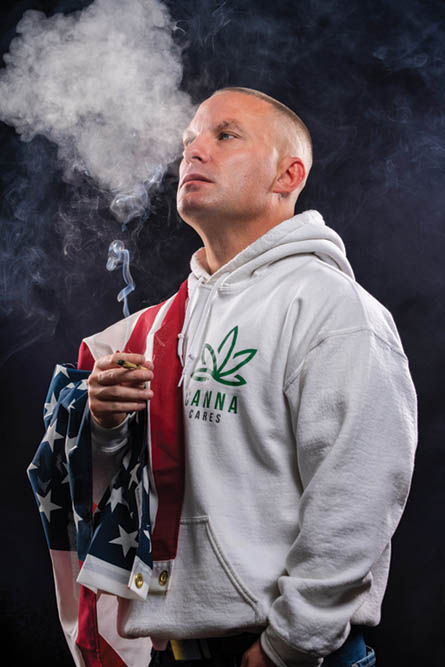
About a year into sobriety, he was struggling with negative effects from prescription medication. He began researching Cannabis and its use among veterans. He had only used Cannabis a handful of times before, always while drinking. He decided to try it intentionally.
“Let’s see what happens if you actually start using this plant intentionally as medicine,” he remembered telling himself.
What Glass wanted most was sleep.
“I personally believe if you don’t have good sleep, you don’t have good anything,” he said. “The first time I used Cannabis, I got a restful sleep. When I woke up, I literally got tears in my eyes and said to myself, ‘Is this how normal people feel every single day?’”
For Glass, Cannabis wasn’t the end of his recovery; it became another tool in it. He also believes veterans deserve serious scientific research into other forms of plant medicine, including psilocybin.
“If you asked me about drugs 10 years ago, I probably wouldn’t have had the same answer,” he said. “But now, I think every single drug out there has its benefit if it’s used in a scientific way with a scientific approach.”
Glass’ philosophy is simple: Veterans deserve more tools, better research and the freedom to find what actually helps them heal.
That belief has led him beyond his own recovery. For the past three years, Glass has been building Canna Cares, a 501(c)(3) focused on Cannabis education, community resources and reducing stigma around the plant.
He wants people to understand cannabinoids, terpenes, consumption methods and the differences between products rather than simply telling them what to use.
“I think a lot of people are gravitating towards Cannabis, but I think there is a severe lack of education,” he said. “Cannabis personally saved my life.”
A man who once mocked 420 now considers April 20 his sobriety anniversary. A Marine who went to war believing in the mission now questions the government that sent him. A man who once avoided his own reflection now spends his life confronting the things he would rather not see.
“There’s just so many things that if I knew then what I know now, I feel like I would be so much further in life,” he said. “Sometimes that actually is a source of frustration for me, but I just have to understand that all this is part of my story.”
Glass doesn’t consider himself religious. But he has come to believe that the seemingly disconnected pieces of his life may not be so disconnected after all.
“If I never went to Iraq, would I have ever used Cannabis?” he asked. “I don’t know. Possibly, possibly not. I just think for a reason, everything is tied together.”
That belief has given him a sense of purpose. Through Canna Cares, he wants to help people ask difficult questions about their health, their medications and what recovery can look like. But he is careful not to present himself as someone who has figured it all out.
“I got so much to work on,” he said. “I have so many character defects. I’m just starting to unplug a lot of these things that are going on in my life.”
Cannabis, he said, “has allowed me to live my life more. It allows me to participate more.”
And perhaps most tellingly, it has allowed him to feel.
“Cannabis gives me empathy; it gives me compassion,” he said. “I cry more now than I ever did, and I don’t think that’s a bad thing.”