
When it comes to concentrates, there are so many factors for consumers to consider. Brands, strains, physical consistencies, extraction methodologies and terpene compositions. The list is practically exhaustive. Knowledge is power, but the amount of information one needs to make an informed decision in the modern-day Cannabis industry can be overwhelming.
For hash, hash rosin, specifically, there’s a metric that seems to be getting more attention and creating more confusion among prospective dabbers.
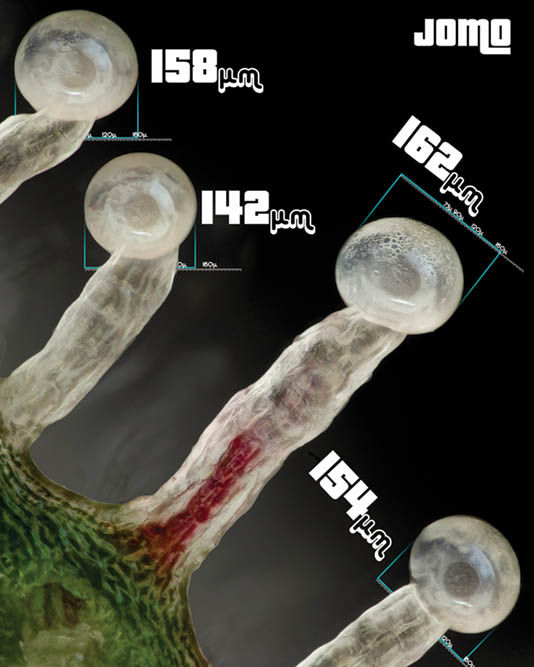
In 2026, it’s fairly uncommon to pick up a jar and not see some variation of numbers and words like “90u”, “70u-119u” or “full spectrum” printed on the label. This number, or range of numbers, indicates the size of trichome heads, or resin granules, in micrometers that were extracted to create the product contained within.
Wash, Sift, Separate
Before we both literally and figuratively get into the weeds here, it may be helpful to review the process by which most modern-day hashish is made. Hashish can be broken down into two categories: dry sift and ice water hash.
Ice water hash, also known as bubble hash, is made by agitating flower in a container of ice-cold water to separate the resin-containing trichomes from the rest of the plant material. Instead of sieving the product with metal screens, as in dry-sift hashish processing, layered microfine mesh bags with variously sized holes are used to collect the resin into distinct strata.
A Matter of Microns
Regardless of which extraction process is utilized, these microns dictate the gauge, or diameter, of resin particles that are collected during the wash process. While dimensions and settings can vary from manufacturer to manufacturer, sizes typically range from the smallest hole, 25 microns (μm), to 40 or 45μm, 70 or 73μm, 90μm, 120μm, 160μm, 190μm and upward of 220 or 224μm (the largest hole).
This raises the question: What is the ideal micron size or range for the best consumer experience? And through what metrics are we measuring quality itself?
The Sweet Spot
“Usually 70u to 159u is the common thing, and the prime stuff is from 90u to 159u,” Camden, of Pua Extractions and processor for Nelson and Company, explained. “But for some strains, it can be anywhere between 70u and 224u. Some plants hold onto their plant material so well that the 160u comes out really clean and flavorful.”
“We sell 70u to 159u on the market,” Jonah Miller of Whale Oil Extracts said. “I will sometimes enter (a portion of) the 90u in competitions because it’s usually a bit lighter, sometimes a little bit wetter. … But for me personally, I like 120u.”
Yet, some marketing in both recreational and traditional spaces seems to push (through pricing, if nothing else) that resin collected via the 90μm bag represents the “best” or highest quality possible, with products made from material found in other ranges representing a less ideal, or less “premium” version.
“I fear equating micron ranges or a specific isolated micron to quality may be doing the customer a disservice,” Stefan Howansky, Oregon Leaf’s Budtender of the Month at AmeriCanna RX, stated. “The 45 to 73 of one plant can be vastly different than another. … I’ve seen grams in the 90u to 149u range that look green.”
Numbered Nuances
It may seem like these numbers serve as an easy reference point for shoppers to judge products, but in reality, micron size might not be a foolproof way to discern hash quality.
“For full melt, certain strains do produce the best melt at 90 microns, but you can also land on any micron, whether it’s the 40, 25, the 70, the 90, 120 or 160u,” Anthony O’Bannon of Roots Rosin and hash maker for Brave Hearts and Lower Left Organics said. “I’ve done side-by-side comparisons of the same strain 73u to 159u and 90u in rosin. The 90u is good, don’t get me wrong, but you’re losing out on some of the profile from the whole fresh frozen plant.”
While it seems that 90μm can be a sweet spot for many cultivars, it isn’t always the case. Some selections, like Chem D, Death Coast and GMO, produce bigger heads on average.
Size by Design
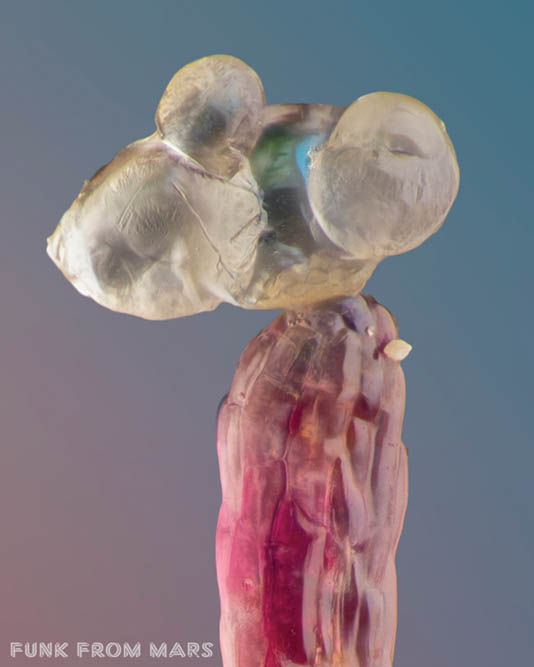
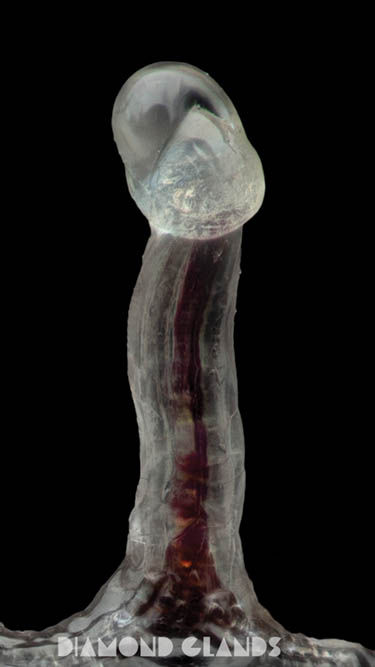
Cannabis breeder Shwale of Farmhouse Studio has spent years researching trichome adaptations and intentionally crossing strains to produce genetics with colossal, multi-gland trichomes.
“The multi-gland trichomes correlate with larger glands and a kind of adaptation to make them even bigger,” Shwale explained. “There’s something going on with the genetics that the plant is going, ‘Hey, I should wall off and separate it to where, if (the resin gland) bursts, it’s not as big of a deal.’ … Whenever you measure the multi-gland trichome itself, it will usually be about 220u or something altogether.”
Larger glands mean more resin, which, in turn, correlates to higher yields during wash. Despite the bulky trichomes intrinsic to Shwale’s genetics, the quality of the resin being processed can still be considered “premium” outside of the isolated 90u.
Everything Else Entirely
Even when the resin distribution is ideal in any individual cultivar being processed, there are still so many variables between growing and hash making that can impact the quality of the end result: the grow medium, use of nutrients, cleanliness of the grow environment or lab, day harvested in the growth cycle, how the flower was handled, fresh-frozen timing, number or length of washes, heck, even the shape of the paddle or machine used during processing!
These factors significantly impact the product’s flavor clarity, medicinal value and overall cleanliness. Of all those important factors, not one is consistently or reliably reflected in the information on the average jar.
So, here’s the scoop — there isn’t really a one-size-fits-all approach when it comes to the microns used in hash production. While some cultivars will have a resin distribution that leads to the highest-quality output falling mostly in the 90μm isolated range, other strains might wash at a higher yield and produce a better end product in other ranges. Additionally, separating microns may protect cleanliness or melt quality in some cases, but it could also be removing some nuance from the expression, including important flavor or medicinal features that dabbers are actively looking for.
Explore, Experiment, Evolve
We know that, in most cases, producers aren’t trying to deceive shoppers. They’re just trying to keep up with a constantly evolving industry. But on a systematic level, it’s still crucial for consumers to explore, experiment and learn about their own preferences when it comes to Cannabis.
It’s similarly paramount for brands to present information in a way that is clear to prospective customers. On a systemic level, we want to make sure we don’t fall into the complacency of propping up any one variable as an end-all, be-all way to quantify quality because that strategy hasn’t gone particularly well in the past (we’re looking at you, THC percentages).
Hype has its place in marketing, but if we want Cannabis to remain an accessible alternative to pharmaceuticals, it’s essential to empower consumers to be more knowledgeable in the way that they access the plant medicine, especially when it comes to concentrates.
After all, with great hash comes great responsibility.