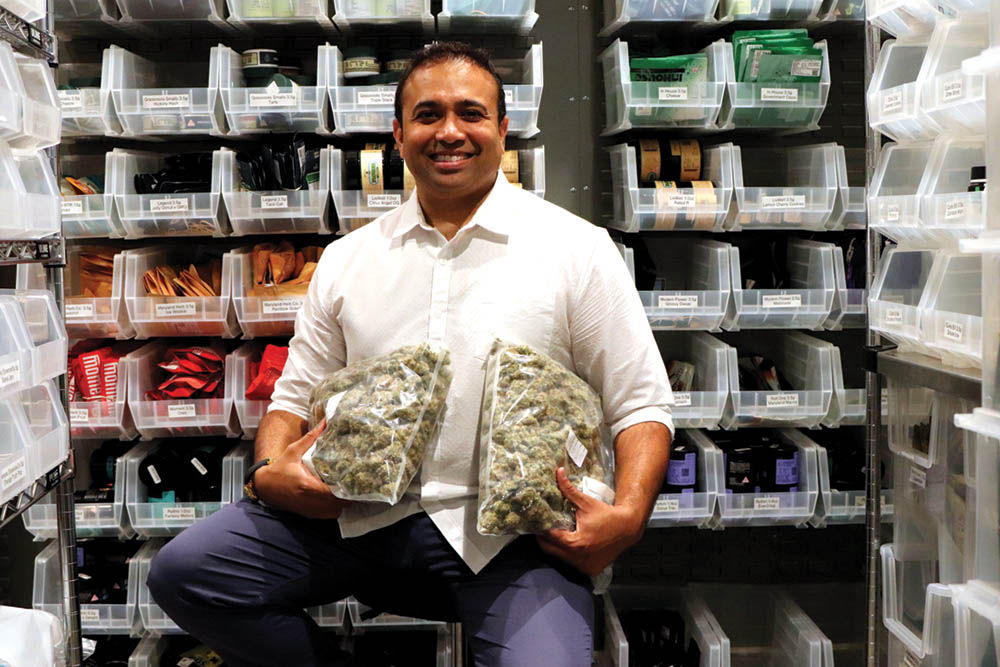
Kal Shah had already called roughly 50 people.
He needed close to $1 million to buy a building, construct his first Maryland dispensary and keep enough cash in reserve to open. But Cannabis remained federally prohibited, conventional lenders wanted little to do with the project and the contributions he gathered were not enough.
Then a family friend suggested another source: borrowing against the cash value of his family’s life insurance policies.
Ten carefully protected family policies — belonging to Shah and his immediate family members — became the bridge between him and a life-changing endeavor.
Together, they borrowed $675,000. Shah added his personal savings.
“We went all in,” he said of his 2017 gamble.
The money helped finance True Wellness in Aberdeen, Shah’s first dispensary. He owned 60%, while an equity partner held 40% and shared the costs. The all-in investment — including the building, construction and operating reserves — approached $1 million.
Shah does not describe the decision as reckless. The family still had an operating Subway sandwich shop and liquor store businesses, and the Aberdeen real estate carried value if the dispensary failed. But the risk was real: construction costs, interest, operating capital and years of accumulated family security were tied to a business the banking industry still treated as untouchable.
Before asking his family to back him, Shah traveled to Colorado, California, Michigan and Canada to study developed Cannabis markets. He spoke with experienced operators, examined the numbers and learned the mechanics of a young industry.
“I had done my due diligence,” he said. “And I felt if all the cards were dealt correctly, I would win the hand.”
Shah, now 44, came to the United States from India with his parents when he was 9. The family first settled in Daytona Beach, Florida, before moving to Maryland in 1996. His father had worked as an accountant in an Indian textile factory before taking various jobs in America.
“I’ve seen the struggles of a first-generation immigrant firsthand,” Shah said. “It instills a lot of grit, a working mentality into you.”
Shah studied computer science at the University of Maryland, Baltimore County and later spent 14 years as a web developer at Johns Hopkins University Applied Physics Laboratory. His workday rarely ended there.
In July 2003, Shah and his family opened a Subway franchise in Windsor Mill. A liquor store followed beside it that December. Shah would leave JHUAPL around 5 p.m., eat dinner, change clothes and report for a second shift. He often returned home around 10:30, slept and started again the next morning.
“I was burning the candle at both ends,” he said. “Fourteen hours a day, seven days a week, 365 days a year for a few years until the new businesses were fully established”
Shah’s interest in Cannabis began with the numbers coming out of Colorado. Once inside the industry, however, his relationship with the plant changed.
He had spent years selling products he rarely or never used. As a vegetarian, he could eat little beyond Subway’s Veggie Delite. Despite more than two decades in the liquor business, Shah said he has never consumed a drop of alcohol in his life.
Cannabis, however, became personal.
Years of lifting cases, stocking shelves and working long retail hours had taken a toll on his back, knees and legs. Shah began ingesting Cannabis to manage pain, sciatica, muscle tension and sleep. He also heard patients describe reducing their reliance on prescription medications.
“With Cannabis, it went from a business to something I enjoy and love doing,” Shah said. “I found my calling.”
True Wellness eventually folded into a larger, four-dispensary operation in Maryland backed by partners out of Arizona. Shah held a smaller stake in that broader company, a move that brought scale but also left him exposed to financial pressures outside his direct control.
In 2023, the four stores were sold to a multistate operator, but Shah said the deal did not put money in his pocket. The Arizona-backed company was struggling to service its debt, he said, and his equity was swallowed by the fallout.
Shah called himself collateral damage.
“I lost almost everything,” he said.
The setback sent him into a depression that lasted roughly six months. His family, Hindu faith and belief in Karma helped steady him.
“When you’re down-and-out, it’s really hard to get back up,” he said. “That immigrant mentality kicked in. You have to get up. You have to find the grit.”
Waave, the Greenbelt dispensary Shah opened in 2020, gave him something to stand on.
The family had nearly repaid the original life-insurance loans. But when Shah needed capital to buy a stake in the former Ethos dispensary in Catonsville, he returned to the policies for another $400,000 — not with the thrill of a first leap, but with the urgency of rebuilding.
“The life insurance policies saved my ass again,” he said with a laugh. “It was my own money, but I had to use it.”
The Catonsville location became Summit Wellness, placing Shah back near the Maryland community where he attended school and built his earliest businesses.
Today, Shah remains closely involved in Summit Wellness and Waave. He wants customers — especially those new to Cannabis — to encounter more than a transaction.
“I’m here to create an experience. … I want the human touch of walking in and really connecting with a patient-care specialist,” he said.
His businesses have also organized school-supply drives, collected roughly 2,000 pounds of food and about 250 winter coats and accessories for local shelters and sponsored expungement clinics.
Shah is actively involved in industry associations and Cannabis lobbying efforts, and he mentors new licensees. He cautions aspiring entrepreneurs against confusing a Cannabis license with guaranteed success — or assuming good intentions alone will create community impact.
“This isn’t a build-it-and-they-will-come business,” he said. “This is like raising a child. You have to put a lot of time and energy into building the business.”
The industry, he added, requires constant innovation. What worked six months ago may no longer work today.
Shah’s own journey has demanded the same.
For all the stores, expansion plans and money at risk, the legacy he wants remains simple.
“I want to be known as the local guy who gives back to the place he came from. I also want to see this industry grow into something much bigger for everyone involved,” Shah said.
Shah is currently expanding by opening his first dispensaries in Woodbury Heights, New Jersey, and New Castle, Delaware, along with continuous expansion in the Maryland market.