The Big Bhang Theory
These days, there are a plethora of pot-infused beverages to choose from… but for thousands of years, there was really only one bud-laced brew: the original Cannabis cocktail, bhang. Sometimes referred to as the “nectar of the gods,” this marijuana milkshake from India has been bringing all the boys (and girls) to the yard since the dawn of recorded history.
What is Bhang?
Originating from the Sanskrit word “bhanga,” meaning “hemp,” the Urdu/Hindi term “bhang” has been used on the Indian subcontinent since the Vedic Period (late Bronze Age) to refer to Cannabis leaves, seeds and stems (flowers are called “ganjah,” and resin is known as “charas”). But bhang’s definition extends beyond just the leaves — it can also mean an edible paste made by grinding up the leaves or a beverage containing that paste: namely, bhang thandai or bhang lassi.
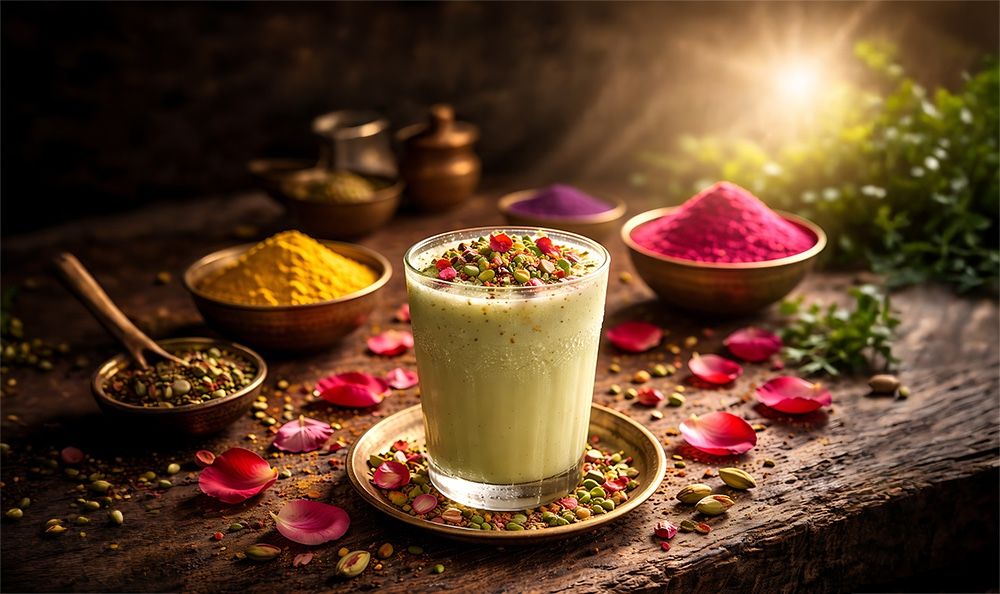
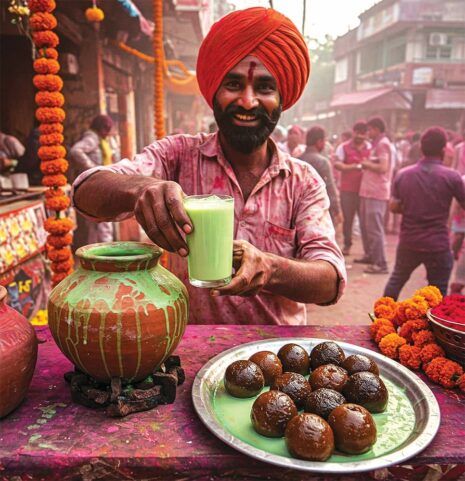
The paste is blended with various combinations of ground nuts, herbs, seeds, spices and warm milk for a bhang thandai (“cooling off”) or yogurt for the thicker version, bhang lassi. The mixture is then cooled and garnished with rose petals and pistachios. The result is a rich, refreshing beverage similar to an iced chai or smoothie that’s said to calm the mind and body. But for Indians, bhang is more than just a deliciously dank drink — it’s integral to their cultural and spiritual traditions.
Lord of the Bhang
The first written accounts of bhang appear in Hinduism’s sacred texts, the Vedas (2000-1400 BCE), which classify it among the most sacred of plants — calling it a “source of happiness,” a “joy-giver” and a “liberator.” Bhang appears repeatedly in Indian mythology, usually in connection with the god Shiva — most famously in the story of Samudra Manthan. According to Hindu scriptures, a group of “Devas” (gods) and “Asuras” (demons) conducted a “churning of the cosmic oceans” (Samudra Manthan) to create an “elixir of immortality” called “amrita” (“ambrosia” to the Greeks). Legend has it that a few drops of this amrita fell to earth, and it is from these spots that the first Cannabis plants sprouted up.
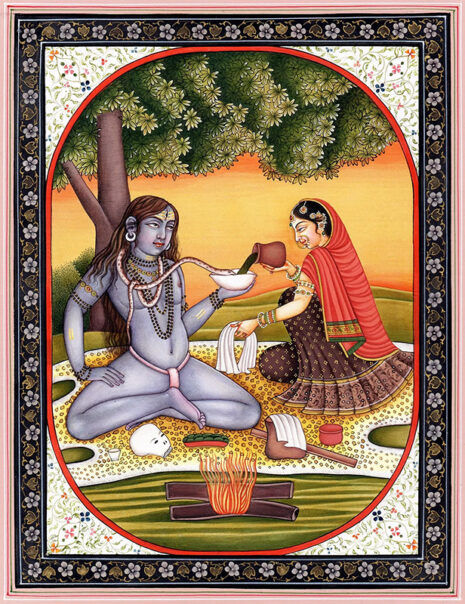
Unfortunately, this cosmic churning also created a poison potent enough to destroy all life called “halahala.” To save the universe from this threat, Shiva drank all of the poison himself, turning his throat blue and causing him agonizing pain. Rushing to his aid, his consort, the goddess Parvati, gave him a cup of bhang, alleviating his suffering.
Another tale recounts an instance where, after arguing with Parvati, Shiva retreats to the mountains, where he falls asleep under a “leafy plant.” Upon awakening, he finds himself hungry and anxious, but feels instantly rejuvenated after chewing the leaves, and brings the plant down from the mountain to gift it to humanity.
Shiva used bhang regularly to relax and focus during meditation, and was even rumored to bathe in it. Since artists have often depicted Shiva with stoney eyes, dreadlocks, and smoking charas or drinking bhang, he’s considered the first “hippie god” and has been bestowed the epithet “Lord of the Bhang.”
Holi Smoke
Given the close connection between Shiva and Cannabis, it’s no surprise that bhang is a sacred component of holidays honoring him. Maha Shivaratri (Great Night of Shiva), which is observed in the Hindu month of Phalgun (February-March), commemorates Shiva and Parvati’s nuptials. During this celebration, Shiva’s worshippers consume bhang leaves and beverages and present them to him as “prasad” (a religious offering).
Another Shiva-related holiday widely associated with bhang is Holi, also known as the “Festival of Colors.” According to Hindu lore, when Shiva’s first wife Sati died, he flew into a distraught rage and performed a “Tandava” (dance of destruction), after which he fell into a trance-like state of mourning. Unbeknownst to him, part of Sita’s spirit survived and was reincarnated as Parvati. When Parvati asked Kamadeva (the Hindu god of love) for assistance, Kamadeva shot a bhang-dipped arrow into Shiva — breaking his trance and causing him to fall in love with Parvati anew. That day became Holi.
Observed on the full moon after Maha Shivaratri, Holi is a joyous two-day festival that celebrates the coming of spring by dancing, singing, feasting, laughing, dousing fellow celebrants with bright colored powders and liquids … and of course, drinking lots of bhang thandai and lassi.
Ayurveda
India also values Cannabis for its medicinal properties, as part of its ancient holistic wellness system known as “Ayurveda” (Sanskrit for “knowledge of life”).
In Ayurvedic texts dating back to the eighth century CE, bhang is prescribed to treat such varied ailments as nausea, anxiety, inflammation, indigestion, insomnia, migraines, malaria, rheumatism and even skin disorders. In fact, it was recommended for so many illnesses that it has been called the “penicillin of Ayurvedic medicine.”
Of course, Ayurveda does not promote full-on intoxication, which it considers an abuse that can lead to mental disorders, such as Tamas (delusion and lethargy) and Rajas (hyperactivity). Rather, it advocates moderate, mindful consumption of bhang to maintain physiological and psychological balance — which, given what we know today about the endocannabinoid system, makes perfect sense.
European Exposure
It wasn’t until the 16th century that the West became aware of bhang. The earliest record of bhang in Europe comes from a Jewish Portuguese botanist/physician in Goa named Garcia da Orta. In his 1534 treatise “Colloquies on the Simples and Drugs and Medicinal Matters of India and of a Few Fruits,” Orta wrote extensively about “bangue” — apparently rejecting the idea that it was the same as English hemp, and explaining how inhabitants enjoyed chewing it, smoking it or grinding it into powder and drinking it with spices because it “intoxicates like opium.”
“The profit from its use is for the man … to be raised above all cares and anxieties, and it makes some break into a foolish laugh,” Orta observed. “Those of my servants who took it … said that it made them so as not to feel work, to be very happy, and to have a craving for food.”
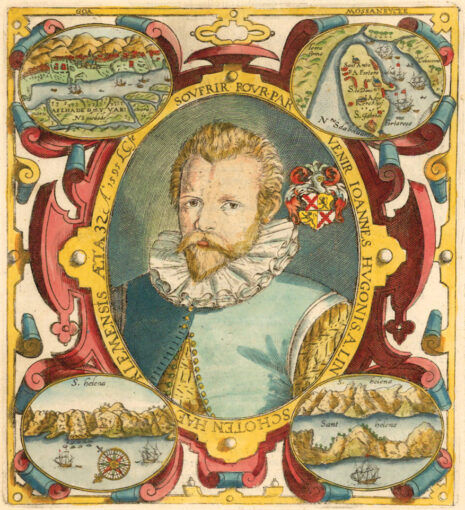
Around 60 years later, a Dutch merchant/cartographer also living in Goa, Jan Huygen van Linschoten, wrote about bhang in his 1596 book, “Itinerario” (aka “The Voyage of John Huyghen Van Linschoten to the East Indies”). In it, he notes that bhang “… maketh a good appetite, but useth most to provoke lust … to reele (sic) and looke (sic) as if they were drunke (sic), and halfe (sic) foolish, doing nothing but laugh and bee (sic) merrie.”
Besotted Brits
The earliest English account of bhang comes from an East India Company merchant captain named Thomas Bowrey. During his first visit to India’s Bengal region in 1673, he noticed that the inhabitants didn’t drink alcohol, but instead found “means to besott (sic) themselves Enough with Bangha and Gangah.”
Two years later, while on shore leave there, he and his men decided to try some for themselves — guzzling pints of the “bewitching” beverage, which they purchased for sixpence each. Describing the effects, he observed that one man “wept bitterly all afternoon,” one was “terrified with fear,” a few were “complimenting each other in high terms” and one “fought with one of the wooden pillars of the porch” until his knuckles were raw. As for Bowrey himself, he confessed that he “sat sweating for the space of three hours in exceeding measure.”
Knox & Hooke
Another East India sailor who was instrumental in introducing bhang to England was Robert Knox. While sailing to Persia in January 1658, Knox’s ship was damaged and forced to port in Ceylon (now Sri Lanka), where the king took the entire crew prisoner. After two decades in captivity, Knox managed to escape and sail to a Dutch settlement on the north of the island. Along the way, he was forced to drink muddy pond water, which made him deathly ill. Luckily, the locals offered him bhang, which fixed him right up.
“… we learned an Antidote and Counter-Poyson against the filthy venemous (sic) water … that after the use thereof we had no more Sickness,” Knox attested in his 1681 book “An Historical Relation of the Island Ceylon.” “It is only a dry leaf: they call it in Portugueze Banga … and this we eat Morning and Evening upon an empty Stomach. It intoxicates the Brain, and makes one giddy.”
After returning to England, Knox was able to procure more “Banga,” some of which he gifted to his friend, scientist Robert Hooke. Hooke spent a month studying the plant, noting in his diary that he found it to be “wholesome, though for a time it takes away the memory and understanding.” On Dec. 18, he gave a lecture at the Royal Society about the herb, which he proposed could “prove as considerable a Medicine.”
Sadly, Hooke’s attempt to introduce Cannabis into Western pharmacopeia was unsuccessful; it would be another century and a half until Britain recognized its medical potential, with credit instead going to Dr. W.B. O’Shaughnessy in 1844.
The Indian Hemp Commission
When the British took control of India in the 18th century, they were reportedly alarmed about the pervasive use of Cannabis there. And so, in 1798, the East India Company enacted a tax on bhang, ganja and charas, hoping to reduce its usage “for the sake of the natives’ good health and sanity.”
In 1893, Parliament took a step further — appointing a commission of medical professionals to launch an extensive study of the cultivation, trade, consumption and cultural/religious significance of Cannabis in Indian society. Published in 1894, the “Indian Hemp Drugs Commission Report” concluded that excessive use of bhang was rare, that moderate use was harmless and that to outlaw it would “cause widespread unrest among Hindu and Muslim communities alike.”
And so, Cannabis remained legal in India for the next 60-odd years … that is, until the dawn of the drug war.
Ban the Bhang?
In 1961, the United Nations enacted the Single Convention on Narcotic Drugs — an international treaty banning all nonmedical drugs that was adopted by 73 nations, including India. However, since the treaty only specified “the flowering or fruiting tops of the Cannabis plant … from which the resin has not been extracted” as a narcotic, bhang was exempt from the ban.
Then, in 1985, under pressure from the U.S., India passed an even stricter drug law — the Narcotic Drugs and Psychotropic Substances Act. Nevertheless, the previous legal loophole held, as the NDPS clearly differentiated ganja and charas from bhang, once again excluding bhang from the prohibition (upheld by India’s high court in August 2022).
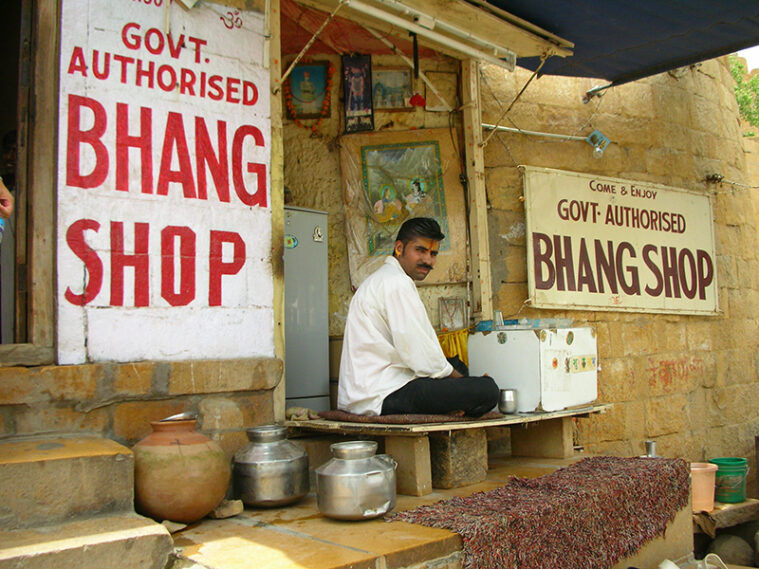
Though permitted on a national level, many states still passed their own laws restricting or outright prohibiting bhang. In towns where it is permitted (mostly in the north), it’s sold in government-licensed shops that regulate how it’s sold and to whom.
Going Out With a Bhang
Regardless of its legality, Cannabis remains India’s most popular intoxicant, with Mumbai and Delhi both listed among the top ten cities in the world for Cannabis use. According to a 2019 survey by India’s Ministry of Social Justice and Empowerment, about 2.8% of citizens (nearly 39 million people) still drink bhang regularly.
After 3,000 years, it’s safe to say that bhang — and Cannabis in general —remain deeply ingrained in India’s spirituality and culture.