“Titan of industry” is the type of term you hear thrown around when people discuss the genesis of a particular field of business, usually when that industry’s beginnings have faded well into history.
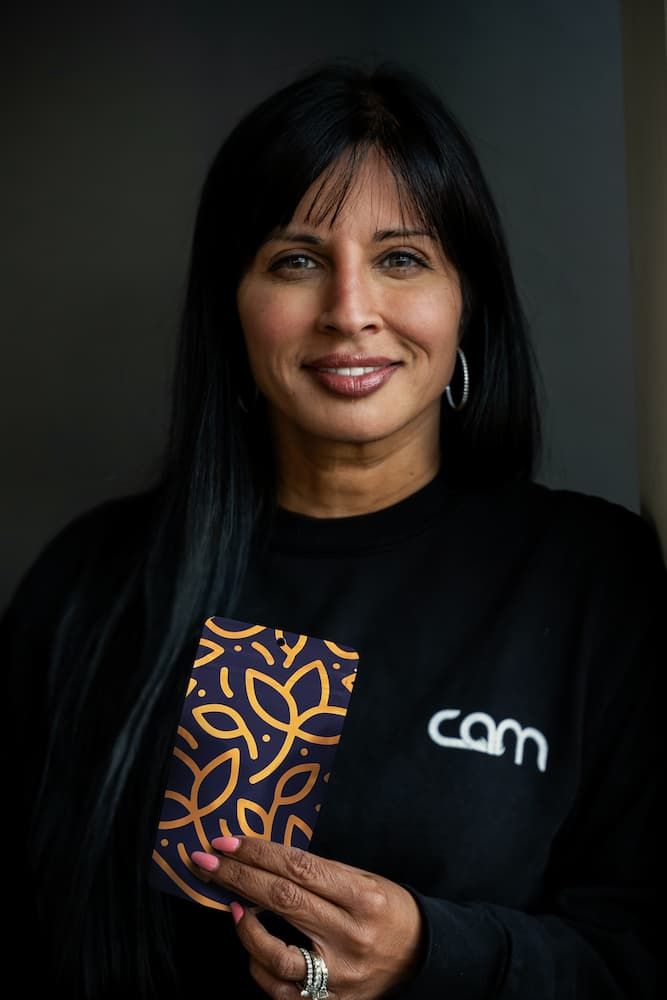
We’re a bit young still to properly identify who the true empire-builders are in our growing sector, but the smart money would put Anna Willey on the short list.
As the founder of CAM — an acronym for California Artisanal Medicine — Anna has taken a brand from a seed of an idea to a lush indoor cultivation ecosystem with more than 5,500 switched-on grow lights in Sacramento alone, run by a team of 200-plus dedicated members.
Anna is building her own CAM subculture within the Cannabis community.
“I mean, they all hang out together,” she said, referring to her team, many of whom have been with her for the entire ride. “Those are all my family. Talk about family style. … We’ve all kind of slept nut to butt in a distro van somewhere. We’re on the floor fucking packaging shit. So it’s been awesome.”
Listening to her talk, she rattles off names of people on her sales and production side like she’s rattling off who she’s excited to see at her family reunion.
“Some of them, they’ve been with me the entire time. And then some of them have come from having 10, 12 years at different farms. … The other big difference of CAM is that my cultivation team adores and hangs out with my sales team. They do their menu planning together. … That trust is built with communication.”
After moving from Colorado, Anna founded CAM in 2018, with her first products hitting the market in 2019. It hasn’t been an easy ride, keeping a company growing and thriving on the financial roller coaster of California Cannabis, with punitive taxation, increased competition and unreliable operators waiting around every corner.
She’s seen and learned a lot in her time building the company. A lot of players have come and gone. Legacy operators like her have a lot of new realities to face.
“If I can be blunt, pun intended, I think that there was an amazing time where you could easily grow wonderful product and put it into a turkey bag and get some pretty decent returns on it,” Anna said. “I think that once that became commoditized and the price became lower and lower … the costs kind of exceeded the price of the investment. And I think that that’s really hard for the people that are very passionate about growing, but maybe didn’t understand the business side as well. And then the folks that are on the business side and making investments are saying, ‘Hey, this is not exactly what we signed up for.’”
There are silver linings to be found, she said, as reality continues to weed out the garden.
“You know what’s kind of cool? There’s a lot of the same players or maybe the same brands and different players, some of that,” Anna said, “but I think the folks that are left in Cannabis right now are ones that still really love weed. You have to really love weed to be doing it.”
Fearless, blunt and unapologetic, Anna puts the protection and prosperity of her company and her team first.
“It seems like focusing on company culture helps build Cannabis culture,” she said, “since Cannabis as an industry has such a vast percentage of Cannabis consumers who are also people who work in Cannabis in some way. That’s a cool thing about weed. I think when you love weed, your whole life is somehow centered around weed.”
She points to the financial security and relative prosperity many of her team members have been able to achieve under her leadership, and is unapologetically proud of enabling the well-being of her crew.
As we’re talking, Anna gestures around at the stark black walls of her newest addition to the collection of CAM facilities in Sacramento: a 150,000-square-foot former Coors bottling plant that’s been converted into space for packaging, distribution, corporate offices and, of course, more cultivation.
“All the people that are coming here have been working practically in the hallways until now,” Anna said, referring to the office staff who recently upgraded their digs. “I mean, we were operating out of 1,100 square feet (of office space). So now everybody’s got offices, and it’s so nice.”
In addition to the new facility, Anna and her team have a number of new projects in store for the coming year. She said they’re getting into making their own rosin under the CAM label, in collaboration with some of their favorite hash makers, including Kalya, Master Makers, Cold Fire and Royal Key.
The CAM team also constantly hunts for new genetics, and they have nearly 60 new additions to their lineup planned for this year. Anna said they’re focusing on the classics.
“I’m trying to grow a lot more gas,” she said. “I’m trying to grow a lot of green weed. The Diesels, the Trainwrecks … It has to smell really good. So I did Cheese last year, a couple of rounds of Cheese. I love it. I love Cheese. I love it. I think it’s great. I think that there’s a lost art form of stinky feet strains.”
One thing is clear from our conversation. While so many people seem to be losing steam as the industry forges ahead into uncharted territory, Anna and the CAM crew are stomping on the gas.
“We’re crushing it,” she said. “We’re crushing it from a cultural perspective, but really we’re crushing it from a making money perspective.” She paused, considering her next statement. “Yeah. Well, I mean, let’s be honest, that’s what it’s all about.”