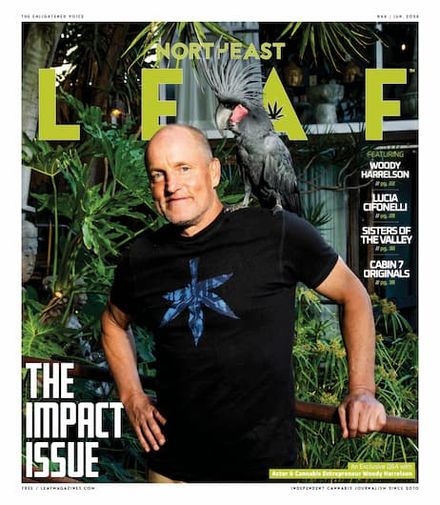
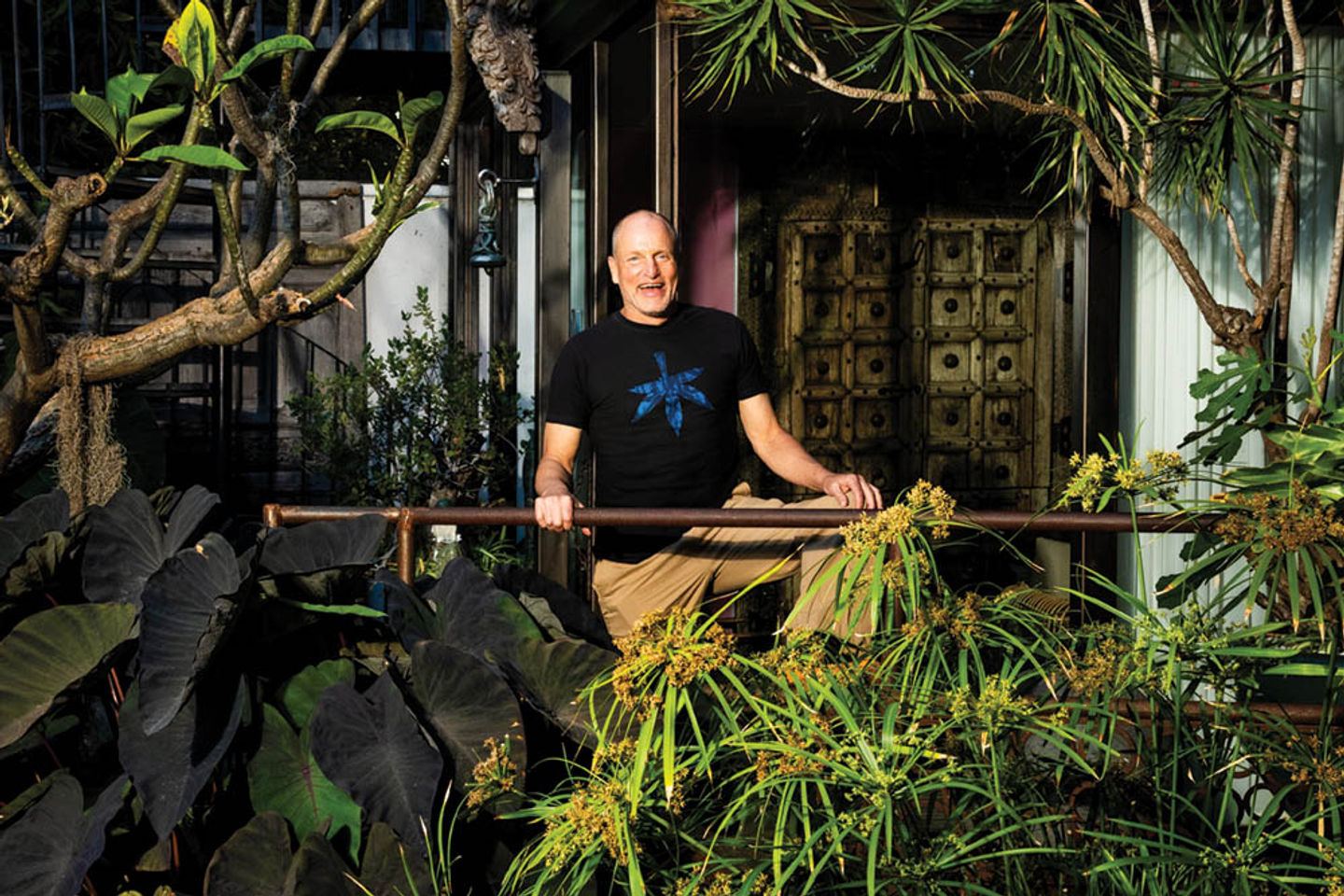
Sharing a hotboxed treehouse with Woody Harrelson in a lush tropical paradise known as The Woods — the smoking lounge off Santa Monica Boulevard he owns with Bill Maher, John McEnroe and Devon “Samba” Wheeler — he settles in for our interview as if meeting friends for an afternoon sesh.
The world has been captivated by Harrelson’s characters on the silver screen, from “Natural Born Killers” to “The People vs. Larry Flynt,” but the best performance he gives is as himself. His natural drawl is relaxing, his vibe unhurried with an air of mirth and the comforting understanding that as a true A-list star, he doesn’t have to act like one.
With a career that began in 1978, he’s seen America and Hollywood evolve and been a voice of reason for healthy living, stewarding the environment and the freedom to enjoy Cannabis. Once a California bad boy for smoky antics, his energy shifted to activism, with notable protests like climbing the Golden Gate Bridge to release a sign saying “Hurwitz, aren’t redwoods more important than gold?” and a symbolic arrest in Kentucky for planting four hemp seeds.
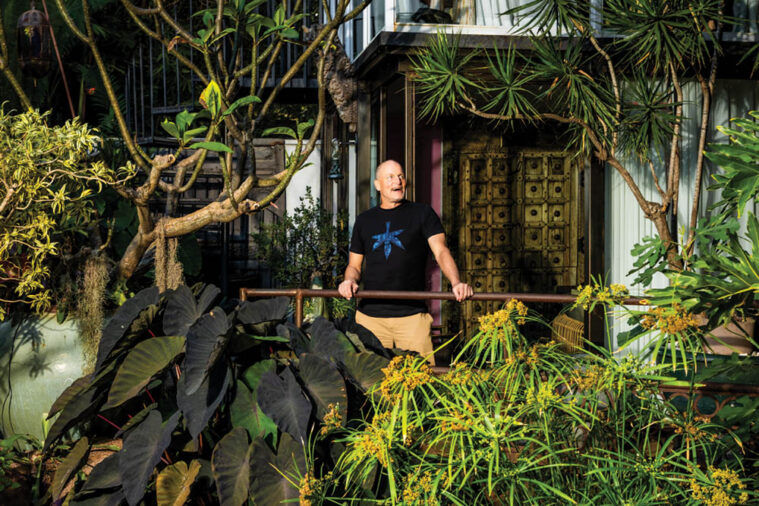
This history is why we honor Harrelson with our Impact Issue cover. His career of smoky mystique in the zeitgeist wasn’t a phase, but a true love for the plant. Far from losing his path or purpose with Cannabis, the plant seems to have steered him through the pressures of fame and the changes of the last 50 years, with Harrelson emerging as a Cannabis success story via a household name.
When you look into Harrelson’s eyes, it’s hard not to see film scenes, like the Twinkie search in “Zombieland” or the simmering, about-to-boil-over energy on “True Detective.” Such is the power of acting, the ability to take on a role and embody it so fiercely that we believe in the scene, the moment, the idea that what we are seeing could be real.
Today, Harrelson gets to play himself. There’s no fame to lose, and speaking on Cannabis is no longer a risk. We see the actor who is able to be comfortable in his own role, that of an advisor, mentor and advocate who wants to share the choices and products that have made his life healthy and happy. For a man who continues to impact countless lives on screen, Harrelson now plants seeds of inspiration at his lounge, where sun-grown Cannabis and good vibes are the menu every day.
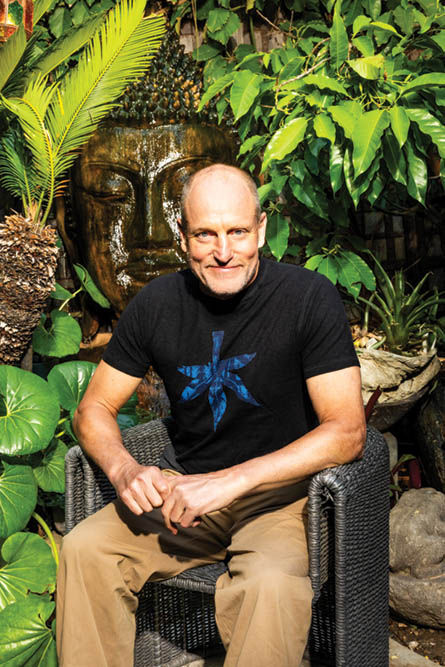
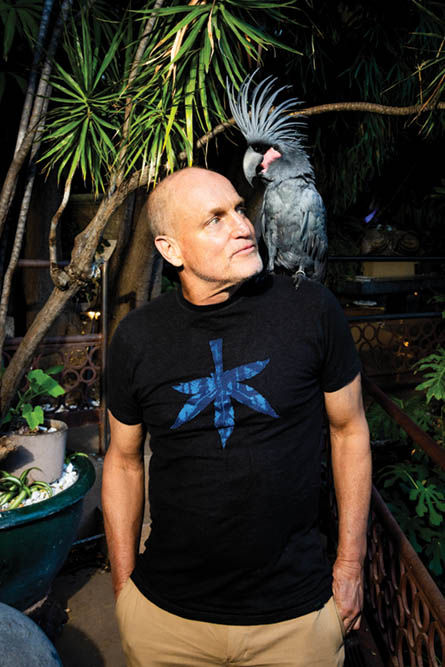
Leaf Magazine: We’re here in The Woods, where people can shop and smoke in a lush tropical setting that’s the most stunning and inviting Cannabis lounge in the world. What inspired you to join the industry, and why a lounge?
Woody Harrelson: My buddy Samba, who opened Erba, would bring me to look at places, and it never felt right until I set foot here in this beautiful Ganja Giggle Garden. I fell in love with the property. I always wanted to open a place that, as a stoner, I would want to go to. I’ve been to places that have smoking on site, some legal and illegal, but none that I would say, “Wow, this is the Shangri-La, this is what you want.” Well, here we have it! But it’s not perfect yet, there’s lots more to be done.
How was the “Club Random” podcast you filmed here with your partner Bill Maher?
Oh, we were fucked up. You should never do an interview that fucked up, but I feel like I’m right on the border now, by the way.
Do you think your other partner, John McEnroe, would have been such an angry tennis player if he took bong tokes before the matches?
I honestly don’t know, but something in me doesn’t think he smoked during his career. He was as dedicated an athlete as you can be. I’ve met the highest-level athletes that smoked. Basketball players tend to smoke, and I found over my rather lengthy career in playing basketball that pot didn’t seem to hurt. It hurt if I was stoned playing, that could hurt, I don’t think that’s a good idea. But for recovery, man, come on, it’s so nice.
Do you smoke weed while acting?
I can’t smoke when I act. Well, the very first time I did that, I thought we were done, and I went upstairs with George Wendt after an episode of “Cheers,” and we start smoking. And then I hear the intercom for me to come do the monologue in scene C that I had tripped up in the performance. So to pick it up, after I thought we were wrapped, I don’t know what the fuck I was thinking. What would have taken once took 10 times, and Jimmy Burrows was like, “Is everything OK?” He’s the greatest sitcom director ever!
Did you smoke weed when you filmed “White Men Can’t Jump”?
There was one moment where me and Wes (Wesley Snipes) are in the car together driving to the location for the scene where I bet him that I can dunk the basketball and I lose, and, uh, unfortunately, we did get high in the car. And I felt like it compromised the scene. It doesn’t work for me because all those things that come so easy to me, suddenly, I get into paranoia, and I’m not comfortable and relaxed, which is really important to be in a state of dynamic relaxation when working in this particular field. For that reason, I cannot smoke and do my job. But I can directly after!
Work first, smoke after?
You know, they call the final shot of a movie set day, on the uh, um … “the martini”! Dammit, that’s what I mean! How many times have I heard martini in my life? Ten million times, and I couldn’t think of it. This is evidence; I’m glad you’re documenting. You can use this for study later on, the documentation of a brain that has just broken down into a little heap of ashes.
It’s like weed inception. You are talking about working stoned while working stoned.
That’s another thing. I never get high and do an interview, but of course, it’s the Leaf Magazine, so I have to get high. And because it was Bill, I had to get high, but other than those two examples, I would never do an interview high.
So the martini is the head-to-the-bar, shoot’s-over call?
Yeah, so we call it “the smoker” ’cause as soon as it’s done, we’re going to smoke. And the second to last one we call “the twister,” to go twist it up! Hopefully, that’ll become new jargon in Hollywood.
Do you think it’s better to start with weed at 21 than alcohol?
I think that straight edge is the best. I’ve always admired straight edge, and thought I would get there. But I seem to be still on the road to … because if the conversation is, “Should I do a drug?” The answer is, “Don’t do drugs.” I almost feel like Ronald Reagan: (imitating Reagan’s voice) “Don’t do any drugs.” There was a time that I had a near photographic memory. Do you know the play “Zoo Story”? Long, long, continuous monologues for this character, Jerry, that I played in college, that I memorized in one Sunday, the whole one-act play. A massive, massive amount of verbiage. And now, I can’t even imagine doing that because I’ve degenerated my memory a bit.
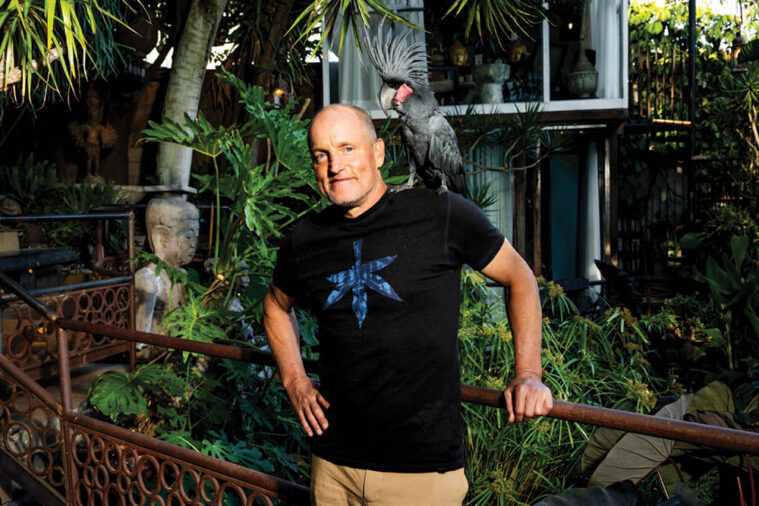
Has your activism affected your brand or status?
That’s hard to say. I think a lot was inspired by playing Larry Flynt in ’96. It made me think about speech, and that’s when we did the Golden Gate Bridge protest. I was inspired and saw the way he lived his life, and there’s a lot I do disagree with about his life, but I thought he was an extraordinary original human, and he made me feel like if you believe in something, do something about it.
Those indecency laws were totally unconstitutional. Did you get to meet Larry and talk about it?
I hung out with him for many, many hours. It’s amazing that indecency was in the courtroom. What’s more indecent than the United States government? And they wanted decency laws! It’s hysterical and ironic.
As a Christian, I believe that God gave us this plant, and so I always felt it hypocritical to criminalize plants like Cannabis, psilocybin or other entheogenic plants. Fighting a war on drugs against a plant is unwinnable.
Well, it is absurd, especially considering that — by the law enforcement’s own estimation of what is — the symptom of Cannabis is euphoria! What does the government have against us feeling euphoria? Because then we aren’t feeling fearful.
I’ve always felt that the right to pursue happiness includes the right to ingest drugs, and that we should only criminalize behavior, not possession. Hollywood is a good example. Wealthy people who do drugs are celebrated, poor people who do drugs end up in cages.
I agree, but you’re talking now of a very important and much larger issue, which is consensual crimes or victimless crimes. There’s no victim to the crime. How is it a crime? Or is it just moralized legislation? In my mind, it’s about the money. The war on drugs, like all war, is lucrative. Somebody is making money with every bomb that drops. It’s the same thing for the war on drugs. There’s a huge industry around that, including private prisons that basically use slave labor. It’s incredible how feudal it all is still.
Who won the war on drugs?
I don’t know, it’s been such a great campaign. It’s been such a great propaganda campaign. You have to give credit to the government; they’ve really made people not give a shit about pot smokers. People who don’t smoke don’t care about the war on drugs; they don’t see the personal level of what happens. Hats off, once again, to Uncle Sam, coming through strong in the propaganda department!
Do you still get excited to be on camera?
Always! But the night before I know what will happen, I don’t sleep. It’s always the same. I get so amped up. But I saw Bruce Springsteen recently in Austin, and we hung out before the show. I said, “Listen, there’s something I always wanted to ask you, and you don’t know how helpful it would be to me to hear you answer in the affirmative. So I’m going to ask: Do you get nervous before the show?” And he goes, “Oh yeah, I would call it anticipatory anxiety,” and said he would be worried if he didn’t feel that. I feel that I still get that the night before the shoot, and then it wears away, and by the second or third day, I’m comfortable. Even with a tense character, I want to be comfortable inside the way I’m feeling.
If there was a lifetime achievement award for Cannabis, you’d be at the top of the list. How does it feel to create a legacy in weed and still be shaping the future of the plant?
Well, I don’t know what I’m doing to shape it, other than having a place for people to enjoy the plant. There was a time where myself and my PR team wanted me to be less associated with herb. And now, of course, having embraced that, there is something beautiful about Cannabis. Of any drug I’ve done, there’s something about the way it brings people together. When you talk about people brought together over cocaine, that’s a different group of people. But this brings a brother and sisterhood of interesting people who are socially, politically, economically diverse, in every way, spiritually diverse people who seem to be attracted to this plant. I love to be a part of this culture. To me, if you are going to do a drug, this is the more benign drug to be doing.
How did you first become acquainted with Cannabis?
When I was a kid, my mom would be, in the morning, having her cup of coffee, and she was a big cigarette smoker. So she’d say, “Son, if I ever hear (mimicking inhale) about you (inhaling) smoking marijuana, it’ll just kill me.” It’s so funny because there’s all kinds of avenues to get drugs into your body, and some people it’s legal, and some people it’s illegal, but it’s still drugs. I always think that the No. 1 drug in the world is sugar.
What was Hollywood’s view on pot when you first came out of the weed closet? Was it always part of who you were as an actor?
Well, everybody smokes, but publicly, nobody was above board on that. For the longest time, it was not OK to say [that you smoked].
When did you first experience the magic of outdoor Cannabis in Northern California?
When I moved here to LA — I don’t live here now — I moved here in the ’80s, and it wasn’t long before I was trying that Northern Cal herb. It’s such a cool, spiritual experience. It’s a very spiritual plant. It’s only our abuse of it that makes it less spiritual. I think if we did it a little more religiously, it would be much better for us, but that’s coming from an addict who doesn’t do that.
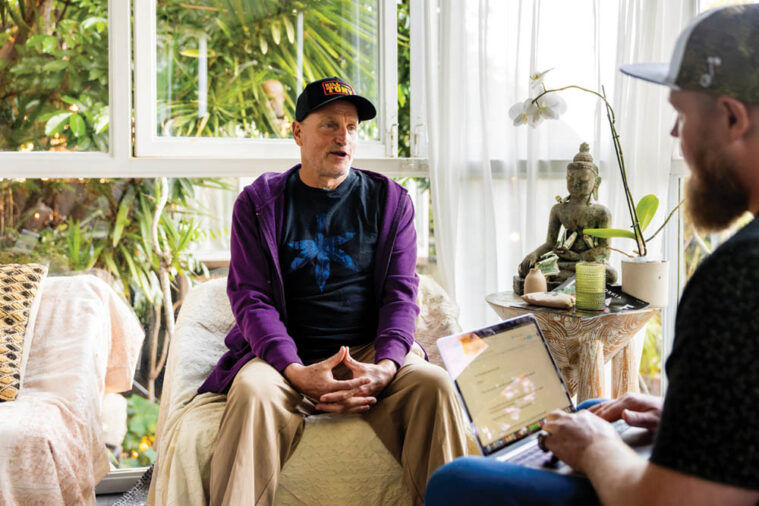
Tell us about your love for the Emerald Triangle?
I just worry about those guys up in Humboldt, Trinity, Mendocino. They’re the best, and they’ve been doing it the longest — multigenerational. And now, because of the popularity of indoor, which befuddles me, I still don’t understand it. To me, the elements that are the most important elements of any herb are three things, aside from the genetics: the sun, water, soil. Those three things make the best herb, and the best herb in the world is grown in Northern California. This is the spiritual fight I feel that I want to have, to use The Woods as a place to testify about sun-grown Cannabis.
Do you identify with the Nor Cal grower lifestyle?
I am a hippie. I love that lifestyle, that really close to the earth lifestyle. And I’ve seen various levels of luxury or comfort up there, but generally it’s pretty rural, close to the ground. There’s a certain primalness to it, just to being up in those mountains, among those beautiful trees, and of course, the trees that they are growing as a crop. It’s really special. I’ve had some wonderful experiences up there.
Is that why you represent sun-grown Cannabis in the dispensary and lounge?
I want to make The Woods a mouthpiece to the Emerald Triangle. I want to speak for the trees, for the outdoor organics, for Northern California. I’m pretty knocked out by the quality of the people, who are kind and devoted, how interesting they are and great at their craft, and they deserve to thrive. I don’t get the disparity in why outdoor organic is so inexpensive compared to indo, when to me, there should at least be parity. It’s odd. But it’s good for people to enjoy the outdoor; it’s less expensive.
The documentary you narrated, “Kiss The Ground,” really explained living soil and regenerative farming in a way that made sense to me, even after touring many living soil weed gardens, where the pot plus the science can get lost in translation. Why are you interested in soil, farming and food?
You think about how incredibly important is the soil, as is the water and the basic things that we need. Soil, water, air, the real basics. They are ironically threatened by our own activity as a species. So you’re seeing a lot of desertification around the world, and the soil is more important than ever. And it’s a very practical way to say here’s something we can do to make a difference in this ecological catastrophic experiment we call modern times.
What prompted you to live as a vegan?
I went vegan Jan 1, 1990. It was a New Year’s resolution, but I’d been wanting to do it since I was 16. I did my first cleanse at 16 — three days of fruit and smoothies — and then I ate a stack of pancakes 3 feet high, and after the second one, I was stuffed. Back then, I wanted to become vegetarian, and my mom and everyone said you can’t do that, you need protein. For some reason, all this time later, I decided to go vegan, and Laura, my wife, did a couple months later. But I’m not entirely vegan; I love honey and an egg if I can be sure of the happy life of the mother. But I wouldn’t go to a random restaurant and eat an egg.
What drove the decision?
Becoming vegan at the time was more of an energetic pursuit. I wanted more energy, and it definitely helped me with that. I used to eat a steak or burger and lay down on the couch and be done for a while. But food is a drug, too. And we are always looking to narc ourselves. Food is really one of the best methodologies for sure. Let’s face it, we’re mostly eating for our tongue, not for the benefit of our body, realistically.
It appears that the industrial food to pharmaceutical pipeline is by design.
I would hate to think it’s as insidious as by design, but certainly it is the product of our times. There’s a continuous stream of what someone is making money off of. Somebody all the way down that line from what we are eating to get sick to those final cash-ectomies before the coffin makers have to make their money. I hate to say it, but it seems as if we are in some kind of “Alice in Wonderland,” some weird dream it feels like, the level of self-destruction that happens.
I’ve always felt that Cannabis opens our minds. Does it have that effect for you?
You think differently after ingesting it. Sometimes it does open a little portal, but I gotta say I’m the last to encourage use of it.
Is Cannabis a double-edged sword for you, that’s helped and also caused you to lose focus?
Yeah, both of those things, but it definitely does help for stress. I’ve never seen any medicine work so effectively for stress. But I don’t use pharmaceuticals, so I can’t say I’ve tried everything.
Does weed make you space out at times?
Oh my God, I’m too high [right now]. This is the thing that’s amazing, as I try to think about my friends in my neighborhood, who are dear friends, and I couldn’t even remember their last names. That’s one thing about this drug, sometimes it just makes you go blotto, like I’m going to go sit in the uh, the uh, theeee uhhh chair! How the fuck does that happen? You’ve seen the evidence!
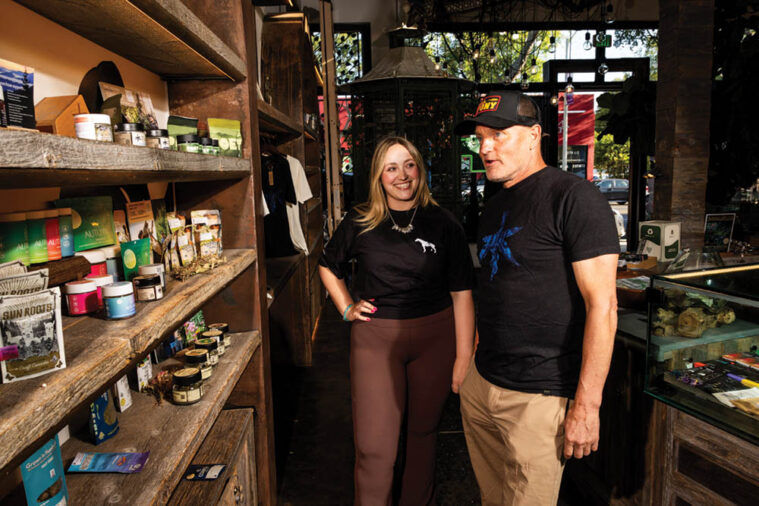
Do you feel like you have built a legacy in weed with The Woods?
With this place, yes, but it’s very difficult because the government wants to fuck you right down the line, start to finish, any way they can. They seem to be just wanting to fuck you. So they don’t give you any breaks. They still treat this industry despicably, especially the overtaxing, the greedy more, more out of the people trying to make a living in the industry. It’s really hard. I hate to go negative, so let me go positive. There’s a lot of good people at The Woods. Every time I come in, I meet new interesting people. I usually come every day when I’m in town.
What is the future for The Woods?
I think it’s going to be about not just the best, cleanest, purest, most delicious and best high herb, it’s going to be about promoting a certain lifestyle of healthy food, healthy products and healthy cleaning products. The shit I use, and if it interests you, you can have some and buy it. Not like a store, but around what I would call “Woods Goods.” Me and my wife use all kinds of cool products and teas and the cleanest fermented coffee beans. I’m being ambiguous about it, but it feels like we can do more here, and I want to do more. I’m basically almost a preacher in my own way, so let this place preach its message, which is a message of regeneration and truth and positivity and cleanliness and good vibes.
Sites & Socials:
thewoodsweho.com | @thewoodsweho | @woodyharrelson